Background
A Lustron House was a post-war innovation to make affordable and durable houses for growing families. Many could buy their first home via the GI bill. From 1947 to 1950, the Lustron company, from Columbus, Ohio, represented the future of housing. Based on a steel frame and porcelain enamel-covered steel panels, Lustron made these homes in a factory and shipped them around the country.
These modest houses were termite-proof, highly fire-resistant, and low maintenance on the exterior. They were complete with appliances and plumbing. Many mid-century gasoline stations used similar enameled steels exterior panels, which require no repainting and were clean and colorfast for decades.
Jackson, Mississippi
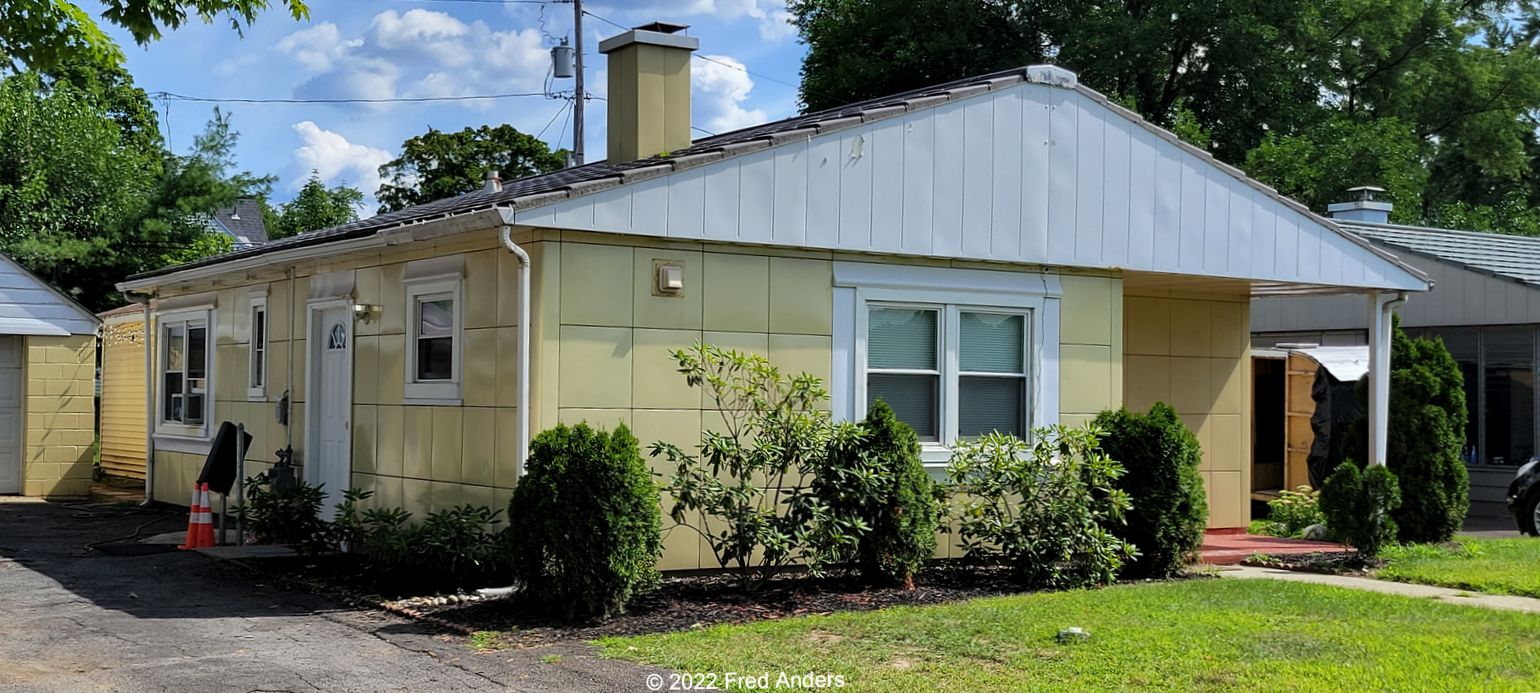
Jackson has at least one steel Lustron House at 144 W. McDowell Road.
 |
| Lustron House, 144 W. McDowell Road, Jackson, Mississippi |
Preservation in Mississippi wrote about the McDowell Road Lustron house in 2010. Shortly after the article came out, I drove to McDowell Road to see the house. A neighbor said it had been unoccupied for two months.
 |
| Note raised slab foundation and gutter channeled down decorative overhang support |
 |
| Original front door matched exterior tile color; ugly add-on burglar bar outer door |
 |
| Contrasting steel window trim and steel roof tiles |
 |
| Handsome bay window marred by ugly burglar bars and nasty awning |
I am awed by how well this house had survived the years. When I photographed it, it was at least 60 years old. The siding tiles are immaculate. Considering the neighborhood where it is located, I doubt the occupants did much maintenance or washing. The nearby conventional houses looked pretty rough in 2010. The April 2022 Google Maps photograph showed trash and filth strewn on the yard.
 |
| 1948 publicity photograph (from Flickr). Note modern fluorescent lights and linoleum floor |
Albany, New York
My friend in Albany took the following photographs of the charming block of Lustron Houses on
Jermain Street Historical District. They are on the National Register of Historic Places. A
Wikipedia article describes their history. The first one below has been re-sided, but the others have their original enameled steel panels. Seventy years later and they are still shiny and bright. Astonishing.
Closing Thoughts
It is a pity that this experiment in steel housing did not thrive. A
Flickr page shows Lustron houses from around the country. I do not know how many are standing.
The Wikipedia article notes:
The Lustron design was created to adapt it to mass production. A steel framing system was devised consisting of vertical steel studs and roof-ceiling trusses to which all interior and exterior panels were attached. The concept of prefabricated housing was well established by firms such as The Aladdin Company, Gordon-Van Tine Company, Montgomery Ward, and Sears in the early 1900s. These companies, however, used conventional balloon-framing techniques and materials in their kits. After World War II, the domestic demand for steel exceeded production and the federal government exercised control over its allocation. Strandlund had orders for his porcelain-enameled panels for use in construction for new gas stations for Standard Oil. He made a request for allocation of steel but was denied. However, he was advised by Wilson W. Wyatt, Housing Expediter during the Truman administration, that steel would be available if Strandlund produced steel houses instead of gas stations.
I would not be at all surprised if conventional builders lobbied municipalities to enact restrictive building codes or other impediments to these innovative housing concepts. And now we have houses built on site from bulk lumber and supplies by workers of varying skills and with huge waste in material. Just look at the scrap lumber, sheet-rock, and debris at any McMansion construction site. The craftsmanship of many new houses is severely lacking; bling without substance. Caulk covers up a myriad of poorly cut panels and timber. Is it time to reconsider a concept like the Lustron Houses?
Ohio Magazine described the Rise and Fall of Lustrons.
An academic article on Lustron houses is "A New Standard for Living": The Lustron House, 1946-1950 by Tom Wolfe and Leonard Garfield, Perspectives in Vernacular Architecture, Vol. 3 (1989), pp. 51-61 (11 pages)
UPDATE June 2025 - Bizarre Political Note: The Lustron Corporation gave $10,000 to the infamous Senator Joseph McCarthy to prepare a pamphlet. McCarthy was not honest about the source of the funds or their purpose. This contributed to his censure by the US Senate.
https://www.nytimes.com/1952/05/14/archives/mcarthy-set-fee-on-housing-article-former-lustron-president-tells.html
"McCarthy Financial Misconduct
Joseph McCarthy was indeed censured in part for receiving $10,000 from the Lustron Corporation under circumstances that were deemed inappropriate. Specifically, the Select Committee found that McCarthy accepted this payment "without rendering services of comparable value" while he was a member of the Senate Banking and Currency Committee, which was investigating the corporation at the time.2 This raised significant ethical concerns, as it appeared to constitute a conflict of interest.
Furthermore, McCarthy was criticized for lying about the nature of this transaction and for failing to disclose his financial dealings adequately. The committee noted that he did not provide a proper explanation for the $10,000 fee, which was seen as an attempt to obscure the true nature of his relationship with Lustron. This lack of transparency and his refusal to cooperate fully with the Senate Subcommittee on Privileges and Elections during their investigation into these matters contributed to the censure.2
These actions were considered to be in violation of the standards expected of a U.S. Senator and were among the key reasons for the Senate's decision to censure him on December 2, 1954."
Can you imagine a politician in 2025 being censured for accepting semi-legal contributions from a corporation, especially considering how the Executive Branch has become a massive kleptocracy? How the world has changed.