This blog documents what remains when we abandon our buildings, homes, schools, and factories. These decaying structures represent our impact on the world: where we lived, worked, and built. The blog also shows examples of where decay was averted or reversed with hard work and imagination.
Wednesday, December 10, 2014
Burmese Days 5: Historic British Houses in Rangoon
This amazing old mansion was once quite a showplace. Look at the Victorian trim (still existent, thanks to the durability of teak), gables, and overhanging soffits. It was designed to cope with a climate that dumped major rain during the summer monsoon and exposed its occupants to stifling heat.
Carriages or Rolls Royces once brought visitors through the breezeway.
The interior must have once been gorgeous. Look at how the same Corinthian column motif from the breezeway was repeated next to the stairwell.
Next door is another old mansion, this one with wide awnings and almost an alpine look. Assuming it was empty, I was about to barge inside and wander around when I saw some recent-vintage cars in the side driveway. Oops, it is occupied. Discretion took over and I headed back to the abandoned house next door.
From the van, we were stopped in traffic for a few minutes right outside another mansion at 105 Kabaaye Pagoda Road. Notice that the gatehouse was modern construction with a rather wild checked pattern.
Recent apartments are rather uninspired architecture and are typically poorly-maintained. The mildew eventually creeps over every surface, and, from what I could tell, the building owners seldom pressure-wash or bleach. The bottles in the lower right are for drinking water.
For another historic Rangoon house, please see my earlier article on the Lin Chin Tsong Mansion.
Photographs taken with a Panasonic G3 camera with Olympus 9-18mm lens or a FujiFilm X-E1 camera. RAW files converted with PhotoNinja software.
Saturday, December 6, 2014
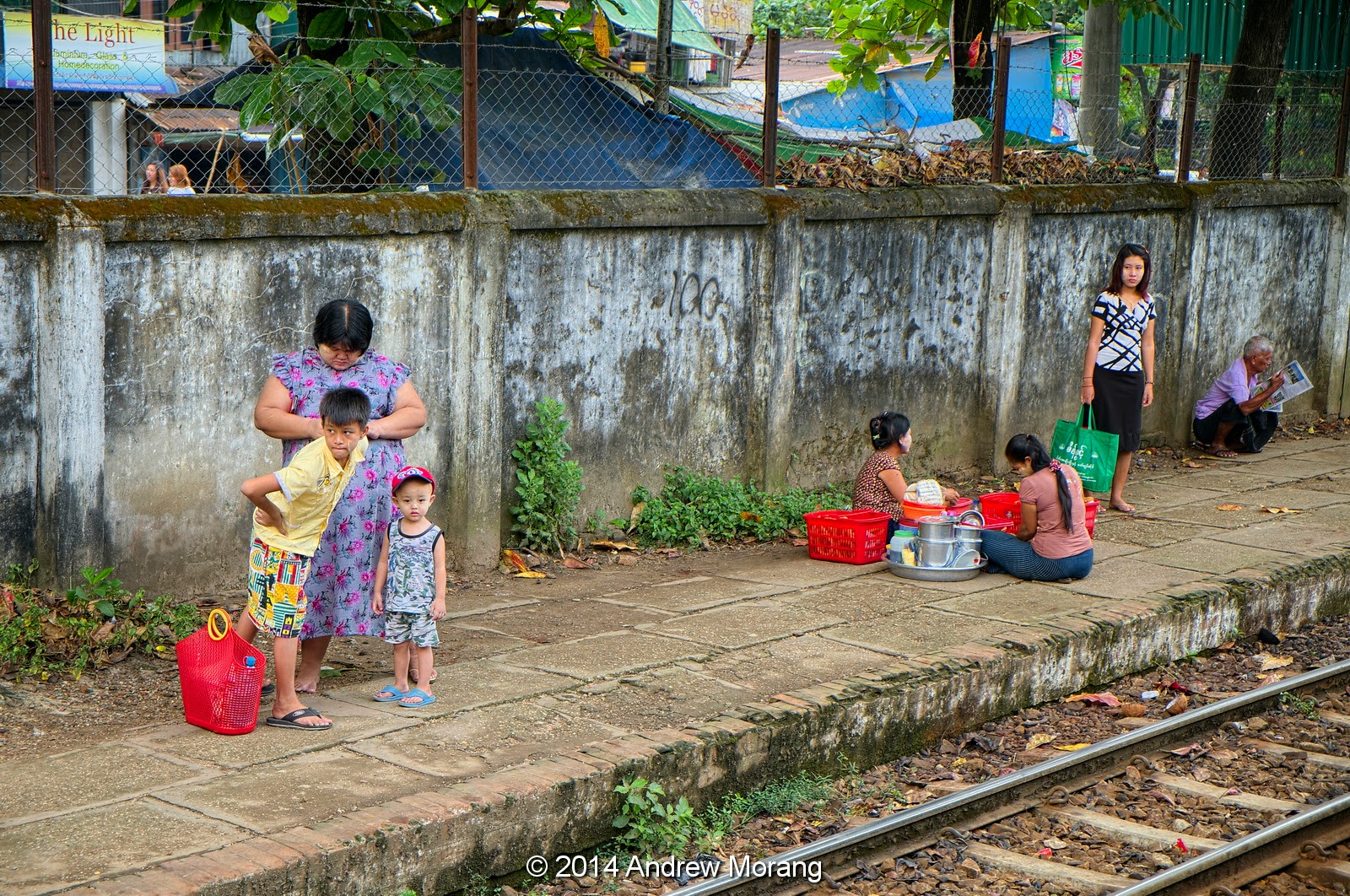
Burmese Days 4: the Rangoon Circle Train
The Circle Train is great fun! Take it.
The Myanmar Times has an article on upgrading the Circle Line. The Irrawaddy describes the Japanese-built air-conditioned train (the one we did not try).
I took these photographs with a Fuji X-E1 digital camera and processed the RAW files with PhotoNinja.
Monday, December 1, 2014
Burmese Days 3: The Rangoon Central Railroad Station
This is the third article on our tour of Rangoon, Burma, which is full of amazing architecture. The Central Railroad Station, off Kun Chan Road, is one of the oddest stations you are likely to ever see. The original on this site was bombed by Japanese planes early in World War II, and the retreating British troops destroyed the remains in 1942. The present building was built (or rebuilt) between 1947 and 1954 based on a design by an engineer Hla Thwin, who used traditional Burmese architectural styles. The four pagoda-like towers are unusual and striking. The grounds north of the station (to the left in the top photograph) once consisted of extensive lawns, but now they are a concrete parking lot.
The size of the Central Station gives you an idea of the importance of the rail network in the immediate post-colonial era. The builders must have assumed that Burma would again be one of Asia's economic powers, as it had been before World War II. Recall that following occupation and wartime destruction, Thailand, Malaysia, Indonesia, Cambodia, Vietnam, and Laos were impoverished and close to starvation (the Green Revolution had not yet greatly increased rice yields).
According to Wikipedia, the Central Station is among 190 buildings on the Yangon City Development Committee’s list of heritage structures worthy of preservation.
The next ticket hall to the east looks similar (and I am not sure why there were two halls), but this one has a modern feature: there is an ATM machine, a recent innovation in Burma (post-2013?). I tried to go upstairs, but all doors were locked. I do not know if offices in the upper floors are occupied.
The shed next to the tracks is quiet, but there are plenty of chairs awaiting their occupants.
The locomotives, rolling stock, and tracks are a bit rough. Older locomotives were imported, but a newspaper article stated that the Burmese were beginning to make locomotives domestically.
Another remnant of the British era is this handsome brick church across the street from the station. I think it is St. Anthony's Catholic Church, but may have written the wrong name.
Once, Rangoon was a city of graceful church steeples, with every possible Protestant and Catholic denomination. It was a melting pot of religions, and you still see churches, mosques, temples, and synagogues only blocks from each other.
For previous articles, please click the links:
The deserted Pegu Club.
The odd Lim Chin Tsong mansion/palace.
These digital images are from my Panasonic G3 camera with 9-18mm Olympus lens or a Fuji X-E1 camera with Fuji 18-55mm lens. I processed the RAW files with Photo Ninja software. I also took Tri-X film pictures here with my Leica M2 camera.
Wednesday, November 26, 2014
Burmese Days 2: Decay at the Pegu Club, Rangoon
Burmese Days is a novel by British writer George Orwell. It was first published in the UK in 1934. It is a tale from the waning days of British colonialism, when Burma was ruled from Delhi as a part of British India – "a portrait of the dark side of the British Raj." At its centre is John Flory, "the lone and lacking individual trapped within a bigger system that is undermining the better side of human nature." Orwell's first novel, it describes "corruption and imperial bigotry in a society where, "after all, natives were natives – interesting, no doubt, but finally...an inferior people."This leads us into the famous Pegu Club, the club for English officers, merchants, and soldiers of fortune. As written in another blog, "It was where linen-suited empire builders could relax and run a colony over cocktails." Built off Pyay Road in the early 1880s on what was then the outskirts of Rangoon, the club was a long teak building with shaded porches and deep overhangs to help fight the blazing summer heat.
Rudyard Kipling stayed there a few days in 1889 during his long journey home. In his collection of travel letters "From Sea to Sea," he wrote: "The Pegu Club seemed to be full of men on their way up or down, and the conversation was but an echo of the murmur of conquest far away to the north." (Kipling 1923).
The Pegu Club mirrored Burma's troubled 20th century history. When the Japanese invaded in 1942, they used the buildings as a brothel. "Postwar, locals were allowed to enter the Pegu Club at last, but few did, perhaps because so little else about the place had changed. “Its long verandahs provided cool and silent shade,” wrote a Shan visitor in the 1950s, “while its polished teak bars never ran out of ice cold beer, Singapore slings, pink gins, or whisky. In the shadows were the Boys [Indian staff], still Boys even if they were 50 or 60 years old, who stood quietly in the background, always ready to anticipate a need and to refill an empty glass.” (Guyitt 2013).
Military dictatorship and socialism followed, and the army commandeered the buildings as an officers' mess. Paul Theroux tried to visit in 1974, but was turned away because a senior officer was having his dinner (Theroux 1975).
A young lady from Hong Kong wandered in alone with a film camera. When she saw my Leica, she asked how long I had been "into" film. I responded since the 1960s. Some Tri-X film photographs of the Pegu club are at this link.
I took these photographs with a Panasonic G3 digital camera with a 9-18mm Olympus lens or a Fuji X-E1 camera with Fuji 27mm lens, RAW files converted to black and white using PhotoNinja software. Of the various RAW processing software packages I have tried, I think PhotoNinja extracts more details - it's amazing.
For another view of the Pegu Club, here is a blog by a visitor from Glasgow.
Kipling, R., and Balestier, C.W., 1923. The New World Edition of the Works of Rudyard Kipling: From Sea to Sea and Other Sketches. Letters of Travel. 2 V. in 1. (Nabu Press ed., 2014), 812 p.
Orwell, G., 1934. Burmese Days. New York: Harper & brothers, 300 p.
Theroux, P. 1975. The Great Railway Bazaar. New York: Houghton Mifflin Harcourt, 342 p.