2024 New Year Note
Dear Readers, welcome to 2024. Thank you all for your support. In the upcoming year, look for a mixture of new material and more treasures (garbage?) from my archives. I also want to scan more of my father's negatives. My New Year's resolution is to sort through much of this old material and purge.
Resolution 2: Don't buy more cameras. But a friend said he would send me his Mamiya RB67..... (And I keep hearing a Leica IIIG and/or Leica M6TTL calling me.)
Resolution 3: Use some of the film in my freezer before buying any more new film. The 120 Panatomic-X is 35 years old. It responds perfectly so far, but its life is finite.
The Kodak Instamatic 500
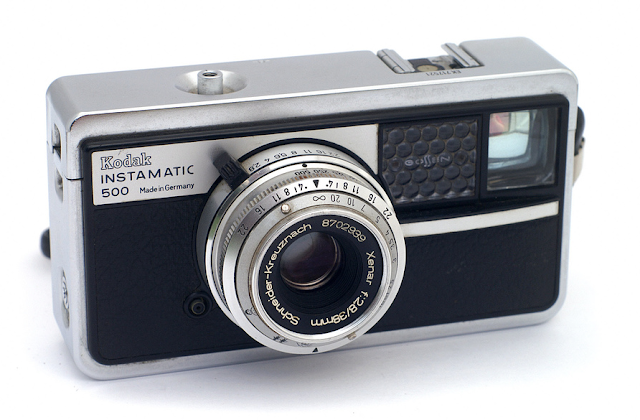 |
| Kodak Instamatic 500 camera (photo source unknown) |
My dad always took pictures. So when I was in elementary school, I wanted a camera, too. My childhood friend had an Instamatic 100 and, later, the 104 (the 4 meant it could accept flashcubes).
In the early 1960s, Instamatics and the associated type 126 film cartridge were Eastman Kodak's marketing marvel, an astonishing sales success worldwide. Kodak introduced the one-piece film cartridge in 1963. The cameras were easy to use. Many casual photographers had endless trouble loading 35mm film into a camera, but the one-piece 126 cassette solved that complexity. All a user needed to do was place the plastic film cassette into the camera and close the back. Most Instamatics were simple cameras with a fixed aperture, but some had early-vintage auto exposure. Some even has a hand-wind spring motor to advance the film.
Kodak sold 126 film until the early 2000s. Their last Instamatic camera was the X-15F in 1988. Mike Eckman has written a detailed summary of the film and its history. He also summarized ways to load 35mm film into recycled or brand new 126 cartridges.
I did not know anything about cameras, so an Instamatic seemed like the logical path. I saved my allowance and, with help from the parents, requested a Kodak Instamatic 500 camera. A relative bought one in Germany and brought it home to Greece.
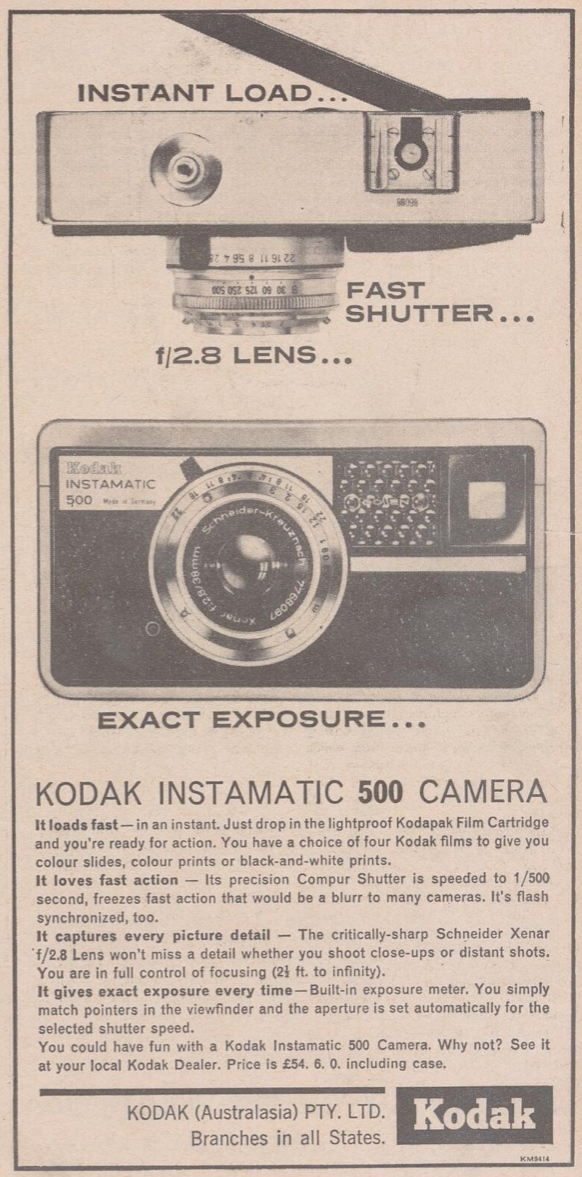 |
| From The Bulletin, August 14, 1965 |
Unlike most of the simple box versions, the 500 let you focus manually and had a built-in Gossen selenium light meter. The 45mm ƒ/2.8 Xenar lens was a modern coated 4-element Tessar type. Mike Eckman wrote a detailed review of the Instamatic 500 and its history, so I will not try to repeat details here. On Instamatic standards, the 500 was capable of decent negatives or slides.
I did not know what I was doing, but the instruction manual said look at the distance scale and turn the aperture scale until the light meter needle pointer was in the middle of the bar in the viewfinder. Simple even for a youngster. Here are some 1964 examples from Greece. The film was probably Verichrome Pan (which I used and liked in 2021 in 120 format).
 |
| Athens view west from Lycabettus Hill |
In the 1960s, Athens was growing furiously. Elegant turn of the century townhouses were being torn down and replaced with rectangle concrete apartment buildings of no architectural merit. Now, some 60 years later, they look like tired nondescript apartment buildings with inadequate elevators, bathrooms, and electrical supply. My 1964 photograph shows the ugly constriction.
 |
| Athens view south from Lycabettus Hill |
To the south, the scene is about the same. The stadium in the middle is the site of the 1896 Olympic Games revival. The suburb beyond is
Nea Smyrni, an area settled by Greek refugees from Anatolia after the disasterous 1923 war and the subsequent exchange of populations between Greece and Turkey (
i.e., forced ethnic cleansing).
 |
| Athens view east |
This is the view towards Mount Hymmetus. Today, the urban sprawl extends a lot further up the slopes. The American Embassy is the modern white building with columns in the center just beyond the green slope. Bauhaus architect Walter Gropius designed the chancery building, which was completed in 1961. I recall when you could drive right up to the building and enter the basement garage. Now, it is surrounded by tall walls and the sidewalks have truck bomb concrete barriers. The concrete ramp in the foreground is part of the ramp for a funicular.
 |
| S.S. Hanseatic in Piraeus |
A trip to see ships in Piraeus was always a treat. This was the S.S. Hanseatic of the Hamburg-Atlantic Line. Built in 1930, this was formerly the Empress of Scotland steamship. The Hamburg-Atlantic Line bought it and extensively rebuilt it, replacing her three funnels with two modern style funnels. Note the open lifeboats, a deadly way to save passengers in case of an evacuation on the open Atlantic ocean. In 1964, passengers still crossed The Atlantic via ocean liner, but the Boeing 707 airliner was in the process of crushing the traditional cross-ocean passenger ship business.
 |
| Unknown sports car near Mount Pendeli |
Update: a reader from Germany wrote that this sports car is an Auto Union 1000 Sp roadster (3 cylinders, two-stroke, front wheel drive).
 |
| Picnic somewhere near Mount Pendeli |
Family friends invited me to a picnic. The stove with all the smoke was a clever Israeli folding camp stove that burned crushed newspaper. I do not know if it could handle the heat of wood or charcoal. Sitting on the rocky soil on newspaper does not look too comfortable.
 |
| My mom and two cousins somewhere near the sea |
A typical Sunday outing was to go to a taverna by the sea and eat. The adults hung about and talked, while the children were bored and ran around. Note the poofy hair in classic 1964 style.
 |
| Sitting around at a taverna |
Yes indeed, here are the adults sitting around at the taverna. The kid looks bored. Don't forget the high-heeled shoes for the Sunday casual outing.
This ends out short look back at 1964 through a Kodak Instamatic 500 camera. As you can see, for internet display, the quality is quite acceptable. I could not find any companies that sell new 126 film, but some adapter kits exist to reload perforated 135 film into 126 cartridges. The Film Photography Project may be trying to reintroduce 126, but I have not kept up with their progress.
I used my 500 for about 5 years and then progressed to a Nikkormat FTn camera in December of 1968. This was a much more sophisticated camera and used the dreaded "complicated" 135 cartridges. The Instamatic stayed in a drawer until a friend borrowed it to use while rock climbing. It disappeared at some stage, but I did not plan to use it again. If you have an Instamatic at home, buy a reloaded 126 cassette and test it - have some 1960s fun.


