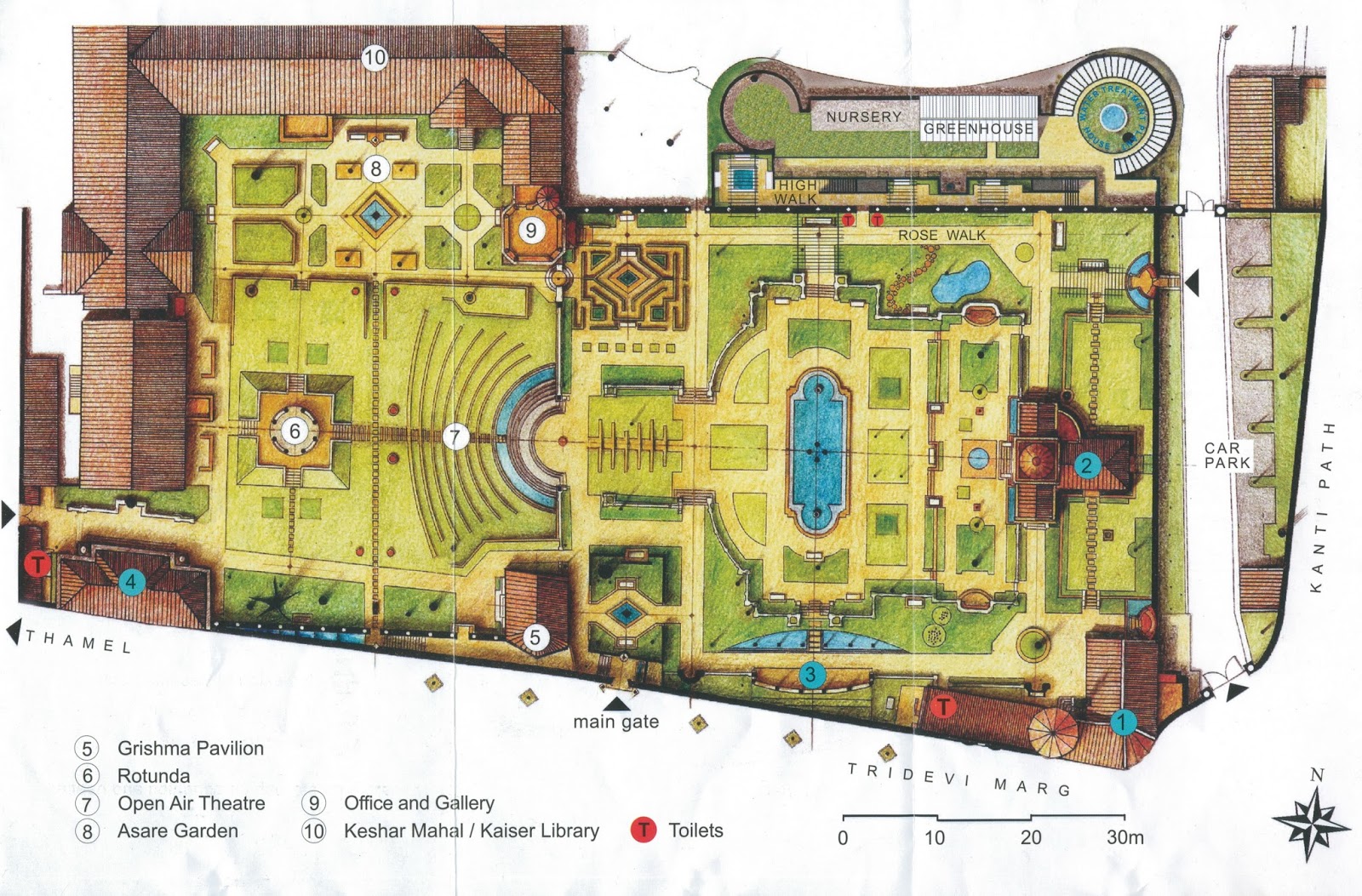
The Ranas (former Nepali leaders) built a number of extravagant palaces in Kathmandu. Many are now being used as government ministries, while others were damaged in the 2015 earthquake and are closed. But there is some good news. The
Ambassadors Fund for Cultural Restoration, funded by the United States, has provided a grant for conservation and restoration of the south wing of Kaiser Mahal. I think this is the section that includes the library but am not sure.
When my friends and I visited the Garden of Dreams in October of 2017, the Kaiser Mahal was a hulking building of brickwork and plaster with only a small section open as a photograph gallery. But looking over a brick wall, we saw the palace east entrance, a dilapidated garden, deserted cars, and junk. Ah ha, urban decay on a grand scale.
Surprisingly, we could walk around the corner to Kanti Path (street) and walk through an unguarded brick entrance. A couple of cooks were cleaning dishes at a tap. And there was the palace, looking quite forlorn. The Department of Education formerly used the building but has now moved.
The architecture is a combination of neoclassical European with Oriental influence. Everything was locked, so we left.
Two weeks later, I returned by myself to Kanti Path. This time, the grounds were bustling, with parked scooters and cars and people milling around. And the Kaiser Library was open! I signed in and walked around. The collection looked like a repository of early 20th century Indian-printed volumes:
Birds of the Indian Garden, or
Sport on HRM's Royal Tour of India and Burma (= shoot many tigers from the back of elephants), or
Journey to Lhasa and Central Tibet (the
amazing story of Sarat Chandra Das, a school teacher turned explorer and spy). The books were damp. The library desperately needs climate control.
A barrier prevented me from going upstairs, but I saw a group with an English-speaking gent go up the stairs and examine the collections and some oil paintings. Dr. Messerschmidt, an anthropologist, told me that many volumes have been stolen because of lax security.
Some background to the library: According to an article in
Wikipedia, Kaiser Shumsher Jang Bahadur Rana was an avid book collector. Kaiser visited England with his father early in the 20th century. "He was very much impressed by the government of England, as well as by the library system and the proper management of books there." He brought home many books, and back in Kathmandu, he established a library in the palace. Eventually, he acquired thousands of volumes. At first, the library was open only to family members and special visitors, but he bequeathed the collection to the nation upon his death in 1964. The good news is the library is still open to students and the public, there is staff during opening hours, and there is functioning electricity. Let's hope this cultural treasure can be preserved.
I took the black and white photographs with a Leica IIIC rangefinder camera and a 5cm ƒ/2 Summitar lens. The color library photographs are from a compact Yashica Electro 35CC camera with 35mm ƒ/1.8 lens using Fuji 200 film. The camera's shutter is electronically timed, so I placed it on shelves, set the self-timer, and let the shutter stay open as long as needed (many seconds); very convenient. The film came from a shop in the Thamel area of town.