In the post-WWII era, Iraq looked like a progressive and advancing country, with active foreign trade, factories, major agricultural output, and (most important) oil. My dad worked on water supply projects there in 1956 for an American engineering company. I assume the work was funded by US-AID, as were infrastructure and water supply projects around the world. This was the short period when the USA was still seen as one of the victors and heroes of the war in Europe and Asia. We funded development projects around the world, fed a starving Europe, and shared scientific knowledge. These efforts led to the green resolution and the virtual elimination of small pox, tuberculosis, and polio. These were the good years before we ruined our reputation with the misguided interference in Latin America, the Bay of Pigs, the disaster in Vietnam, and a useless war against Iran.
In the 1950s, Iraq was awash with oil money. The government even commissioned Frank Lloyd Wright to develop a Master Plan for Baghdad. None of it was ever built, so my dad did not enjoy any of Wright's extravagant architecture (such as the opera house on an island in the Tigris!).
 |
| Al-Rashid Street, Baghdad |
Al-Rashid was a major thoroughfare, but no Frank Lloyd Wright influence yet.
 |
| Tigris River from Zia Hotel |

 |
| Haydar Khana Mosque, Baghdad |
 |
| Super stewpot, probably the Souk al-Safafeer, Baghdad |
Souk al-Safafeer was Baghdad’s ancient coppersmiths’ market.
Agatha Christie's heroine, Victoria, came across the Souk on her first day in Baghdad:
"And then, as she walked along the street, a prodigious hammering and clanging came to her ears and peering down a long dim alley, she remembered that Mrs. Cardew Trench had said that the Olive Branch was near the Copper Bazaar. Here, at least, was the Copper Bazaar."Victoria plunged in, and for the next three-quarters of an hour she forgot the Olive Branch completely. The Copper Bazaar fascinated her. The blow-lamps, the melting metal, the whole business of craftsmanship came like a revelation to the little Cockney used only to finished products stacked up for sale. She wandered at random through the souk, passed out of the Copper Bazaar, came to the gay striped horse blankets, and the cotton quilted bedcovers. Here European merchandise took on a totally different guise, in the arched cool darkness it had the exotic quality of something come from overseas, something strange and rare. Bales of cheap printed cottons in gay colours made a feast for the eyes."
 |
| Villagers walking past an archaeological site (or cemetery?) |
 |
| Checking out the date harvest |
 |
| Ruins of the Arch of Ctesiphon. Note the massive base. |
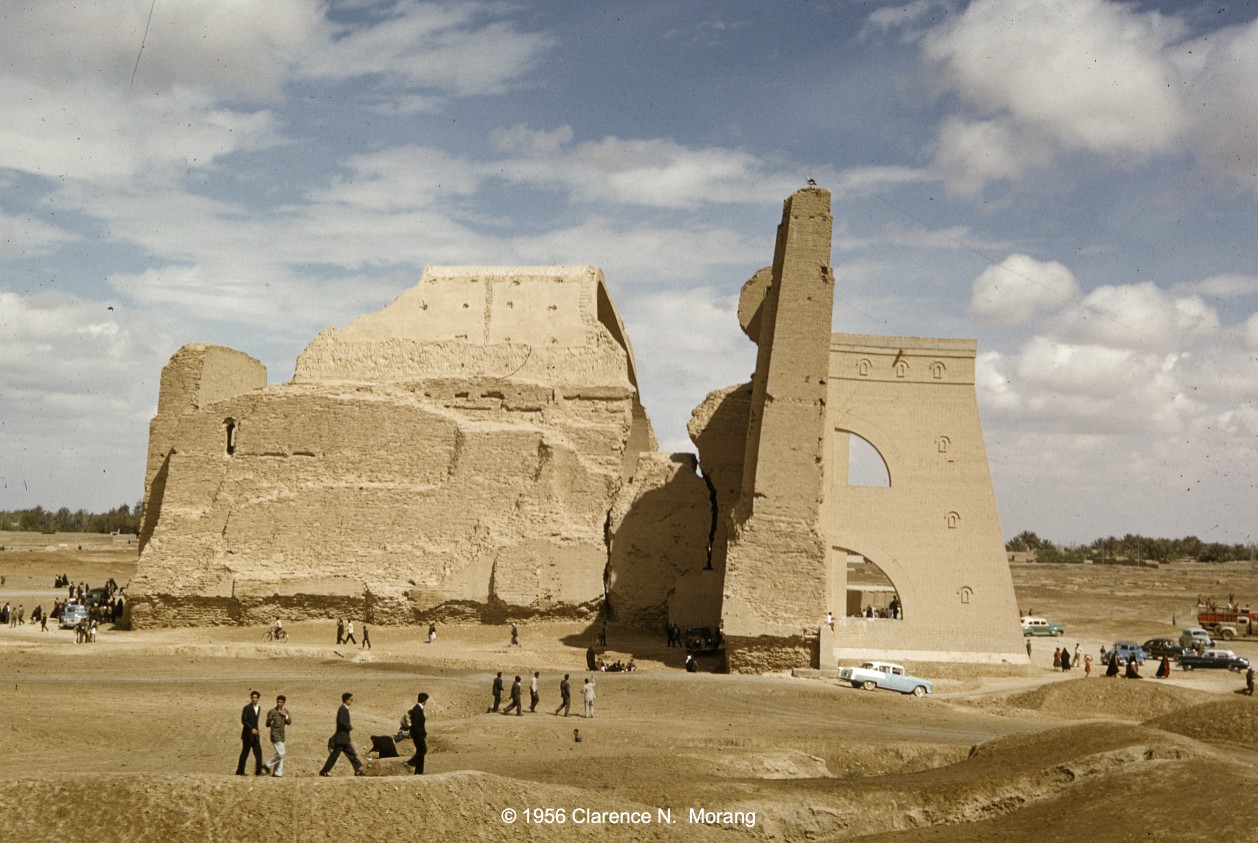 |
| Ruins of the Arch of Ctesiphon. |
 |
| From Alamy via The Economist. |
 |
| Early-to-mid-1900s passenger network, from The Economist |
This ends our short visit to Baghdad. My dad's employer never signed a contract for hydrology projects in Iraq and we never moved there. It would have been an adventure.
My dad took these pictures on Kodachrome film with his Leica IIIC camera and its 5cm ƒ/2 Summitar lens, the same package that I occasionally use today.

6 comments:
Those Kodachrome slides are marvelously preserved.
Thanks. Kodachrome slides were amazingly durable as long as they did not get exposed to too much humidity, which resulted in fungus. The colors were much more stable than the dyes in early Ektachrome or Agfachrome slides.
The photographs are beautiful and present such an interesting perspective, especially with your commentary.
Good post.
what a beautiful pictures from my home country. I appreciate if you can share more photos from your dad's archive. These photos are wonderful.
Thank you for your kind comments. Unfortunately, I do not have more Iraq photographs because my dad did not stay there more than a month or two. We never lived there on a long-term basis. (Sorry for the tardy response.)
Post a Comment