Showing posts with label Vicksburg. Show all posts

Tuesday, January 17, 2012

1923-vintage Bungalows on First North, Vicksburg, Mississippi

First North is one of Vicksburg's historic streets, running north-south in the eastern part of the city. At the junction with Harrison Street, it continues south with a new name, Court Street.
On the east side of First North, the line of bungalows at 1511-1517 have a common ancestry. (They are outlined by the circle on the map.) A friend at Mississippi Department of Archives and History sent me this text from the Vicksburg Evening Post, June 13, 1923, about these homes:

MODERN HOMES AT MODERATE PRICES THROUGH SWITZER
Something About Bungalows in First North Street

Within about four weeks, perhaps the first of the modern, moderate priced bungalows being constructed by Louis Switzer, First North Street, between Harrison and South will be completed and placed on the market.

Mr. Switzer is to build five of these houses--six room bungalows. Each home will include a living room, dining room and a kitchen, two bed rooms, bathroom, hall and sleeping porch.

There will be gas, electricity, water, and all the sanitary conveniences.

Mr. Switzer is planning to sell these homes for a price between $1,000 and $5,000, and he will sell on an easy payment basis.

Lumber for the houses is being secured by Mr. Switzer from his own mill at Oak Ridge, high grade poplar and gum being used for the framing.

Purchases Truck

For hauling the lumber from Oak Ridge to Vicksburg, Mr. Switzer has just purchased a truck. Owning his own sawmill and getting his lumber at cost will enable Mr. Switzer to build the new homes at a cheaper figure than would otherwise be the case.

"I am building these homes for the average man," Mr. Switzer said commenting on his plans. "Every man, of course, ought to own his own home, and I will make it possible for this average man to secure a cozy, comfortable home at a price that will be within his reach."

J.W. Sacks is the contractor building the bungalows for Mr. Switzer.

Mr. Switzer announces that his First North street bungalow proposition is to be something new in Vicksburg. It will be a complete "move in" affair. His new homes are to be completely furnished--furniture, fixtures, stove, everything set up ready for occupancy.

After a man buys one of these homes all he will have to do to feel at home is to enter the bungalow and hang up his hat.


Now only four of the bungalows still stand, The southernmost one, at the corner of First North and Harrison was torn down at least a decade ago. The lot is now a garden. The photograph above shows no. 1517, presently the southernmost unit.
Moving north, the second house is 1515, with a cheerful paint job.
The third house is 1513, still with its original porch but with modified posts.
Finally, the northernmost unit is 1511. It has been renovated and has a larger attic than the other bungalows. I talked to a lady who lived in this house and she told me she grew up in the neighborhood. She formerly lived on Grammar Street, which is a block away and will be the subject of a future blog entry.

(Digital images taken with a Panasonic G1 digital camera with a Lumix 14-45 mm lens.)

Tuesday, January 10, 2012

Cotton Compress, Levee Street, Vicksburg, Mississippi

For many years, a complex of brick and steel sheds stood on the west side of Levee Street close to where the historic Fairground Street bridge crosses the Kansas City Southern railroad yard. This was the cotton compress, address 2400 Levee Street (see the circle on the map).
This post card, circa. 1911, is from the Ann Rayburn Paper Americana Collection, Special Collections, University of Mississippi Libraries (originally from the International Post Card Co., New York, N.Y.).
This is a glass negative from the George Grantham Bain Collection at the Library of Congress, with title, "Louisiana Flood 1912, Cotton Compress at Vicksburg as a refuge." I am not sure if any of these buildings still stand.
According to a December 17, 2010, article in The Vicksburg Post, the compress facility dates to 1903 and formerly housed a cotton gin and 13 warehouses and sheds with about 340,000 square feet of storage space. The view above was taken from the top of the levee looking east at about the same location as the 1912 flood photograph. Vicksburg is on the hill in the distance.
These two views show part of the complex from Levee Street. The Post did not specify how long the compress had been unused, but the buildings were in poor shape because of water damage and asbestos exposure following years of vacancy. Notice the sign on the ground with scripture.
This press was under the tower in the upper photograph. I do not know the mechanics of how it worked, but I remember seeing steam and activity in the 1980s, when this was still a going concern.
A developer told the city's Board of Architectural Review that the Vicksburg Compress company planned to use some of the buildings as a self-storage facility. Other buildings would be demolished, and the 1940s water tower would be removed because it was unsafe.
The interior had typically interesting industrial archaeology to examine (and I like exploring places like this). Notice the large wood timbers holding up the roof.
The grimy old workbenches still had tools, pipe, and cans of chemicals strewn about.
You could even wash up...maybe.
Someone had stored some old American muscle cars, but they were in no better condition than the buildings.
While I was exploring on a December day in 2010, a small team was cleaning up bricks and loading them on pallets.
As of December 2011, many of the brick walls are gone, and I assume the bricks have been sold. But the steel sheds are still unused, and the water tower is still standing. These projects tend to take a long time in Vicksburg.

An interesting article on cottonseed oil mills is in:  Wrenn, L. B. 1994. Cotton gins and cottonseed oil mills in the New South. Agricultural History, Vol. 68, No. 2, Eli Whitney's Cotton Gin, 1793-1993: A Symposium (Spring, 1994), pp. 232-242. (Published by: Agricultural History Society)

These are digital images from a 10 megapixel Sony R-1 digital camera, tripod-mounted. The interiors were multi-second exposures, good examples of how well-suited digital cameras are for low-light conditions. You no longer have to worry about reciprocity failure and color shifts as with film; just set the exposure and let the shutter stay open as long as needed. The R-1 has a superb Schneider lens.

Some black and white Panatomic-X film photographs of the compress are in my 2018 article (please click the link). 

Saturday, December 17, 2011

Hoben's Country Store, Old Hwy. 27 and Warriors Trail, Vicksburg, Mississippi


This traditional wood-frame country store is at the junction of Old Highway 27 and Warriors Trail, southeast of Vicksburg. A decade or two ago, it was still open for business, but I am not sure when it closed. Possibly a reader can provide some information. Somewhere in my files, I may have a Kodachrome slide of this store in operation.


At one time, small locally-owned stores like this were found along rural roads throughout the south because rural farm workers did not have cars and had to walk or ride a wagon to get supplies. Needless to say, they are a dying institution, and the remaining examples are falling down, burning, or being torn down.


The roof on the main building is still intact, and it looks like the owners have been storing miscellaneous junk for awhile. Notice the wood boards forming the interior walls. Ultimate fate: unknown.

(Photographs taken with a Panasonic G1 digital camera with 14-45 mm Lumix G Vario lens, ISO 100, December 17, 2011.)

Sunday, December 11, 2011

Abandoned Machine Shop, Levee Street, Vicksburg, Mississippi

From the late 1800s to mid-20th century, Levee Street, running parallel to the floodwall and the Yazoo Canal, was lined with warehouses, cotton compresses, railroad shops, grain elevators, and oil storage farms. Most are now gone, and Vicksburg is no longer an industrial city. The postcard above, from the Mississippi Department of Archives and History, shows the waterfront view from the roof of the First National Bank Building. Levee street is in the distance. In the 1980s and 1990s, this steel building (across the street from the Kansas City Southern railroad yard) contained a machine shop. I am not sure who it served, but it was a going concern, and I recall hearing metal noises and seeing pickup trucks coming and going. Now it is closed and used for junk storage. I wish I had kept a 1980s telephone book to use as a data source to identify old companies like this. The south side of the property is a dumping ground for all sorts of metal debris and parts from the railroad. This is a housing for a track-switch lever and mechanism. I like railroad equipment - heavy duty, built to last.

(Photographs taken with a Fuji F31fd digital camera at ISO100, 24 Nov. 2011)

Update: Here are some black and white film views of the workshop from December, 2020.

Friday, November 25, 2011

Levee Street Railroad Warehouse Demolition, Vicksburg, Mississippi

The 1870s warehouse/office, built by the Louisville, New Orleans & Texas Railway, has been demolished. The photograph above shows the site at the Kansas City Southern railroad yard on Levee Street, Vicksburg. Please see the August entry for photographs of the standing building. I was out of town when it was torn down and do not know what happened to the bricks.

Update Sep. 3, 2017: I added this 1990 photograph of the warehouse to remind viewers of its once handsome appearance. This is a scan of a 4×5-inch Fujichrome 50 transparency, taken on a B&J camera.
The rail yard is much quieter now than before the spring 2011 Mississippi River flood. Ten and twenty years ago, the yard was always packed with rail cars, but now the tracks are mostly empty.
Here is a photograph from 1990 taken from the ramp that leads to a gate in the flood wall. The cars belong to workers who are offshore. As you can see, the rail yard is well-filled with rail cars. (Scanned from a Polaroid Type 54 4×5-inch print, taken with a Tachihara 4×5" camera with 90mm f/6.8 Wollensak Raptar l

ens).

Saturday, August 20, 2011

Shotgun Shacks, Rigby Street, Vicksburg, Mississippi

Rigby Street is an out-of-the way dead-end lane west of Washington Street. Drive west on Polk Street, cross Washington Street at the fire station, and you are on Rigby. The houses in these photographs were west of Oak Street.


Once there were probably tens of shotgun shacks lining both sides of the street, but in 2006, only four were left. They were examples of the ubiquitous narrow one-floor wood houses built in great numbers during the early 20th century. The first one beyond Oak was 507, occupied in May 2006 when I took this photograph.

The second was 509, also occupied and reasonably neat.


No. 513 had clearly been deserted for years and was being overtaken by the vines. This reminds me of shows on the SyFy channel, were evil vines overcome and squash a house, often with the occupants inside.

513 had once been fixed up with wood paneling on the walls. The original fireplace had been boarded up. You can see wood tongue-and-groove where the door trim has been removed. I am not sure if the walls were ever plastered or if originally they had cheesecloth tacked to the wood with wallpaper over the cheesecloth (a common practice here in the late-1800s and early 20th century).

As of August 2011, all of these houses are gone, and the jungle has grown so luxuriously, there is little evidence that the house lots ever existed.

(Photographs taken with a Sony DSC-W7 digital camera.)

Friday, August 12, 2011

Railroad Warehouse, Levee Street, Vicksburg, Mississippi

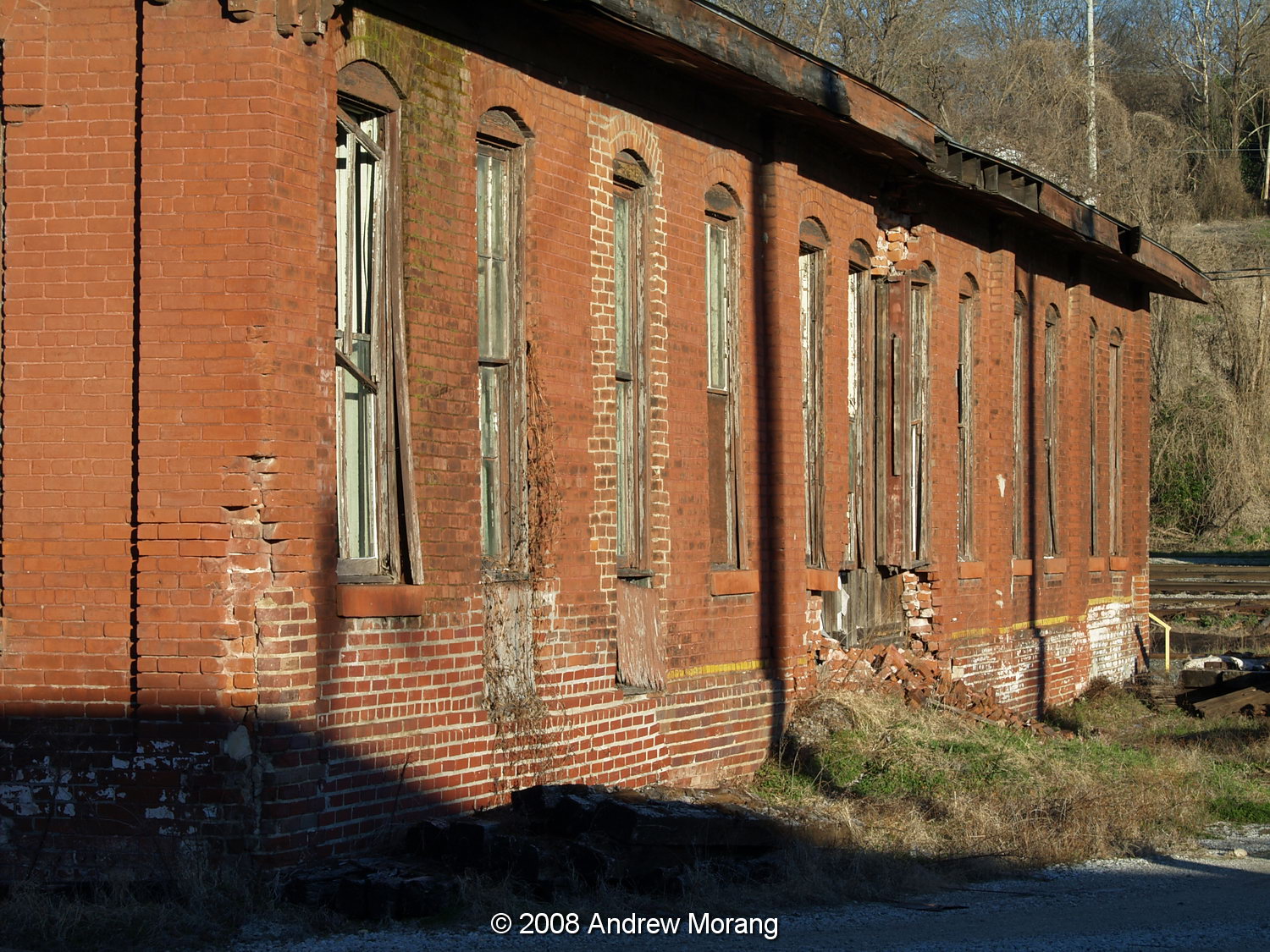
Drive on Levee Street in Vicksburg south of the waterfront and the casino, and you soon reach the Kansas City Southern railroad yard. This is a historic railroad yard and has been in continuous use since before the Civil War. There is still a turntable, and there was once a brick roundhouse, but it was demolished sometime in the 1970s, I was told. One remnant of the 1800s remains, a forlorn and sad but once handsome brick building. According to the Vicksburg Post (20 January 2008), it was once a warehouse and work shop for steam engine supplies, but it now sits neglected and deteriorating.

Some Vicksburg residents do not know about the warehouse. The view above shows the railroad yard from Klein Street, looking west. The steel building beyond is part of the Anderson Tully wood mill.

This is the west side of the building, seen from Levee Street. A marble plaque above the louvered entry shows "L. N. O. & T. 1890, R.T. Wilson, President, J.M. Edwards, Vice Pres." According to the Mississippi Rails web page, the abbreviation stood for the Louisville, New Orleans & Texas Railway, in operation from 1884 to 1892. It was sold to the Yazoo & Mississippi Valley Railroad in October of 1892 (this is the name on the Vicksburg Depot, highlighted in a previous blog entry this year). As of December 2010, the plaque had disappeared from the facade.

The south side has a section of wall that is collapsing. Some of the window sashes had broken and the glass has fallen out.


The north side had a loading dock. Overall, it is in as bad condition as the south side.
As of 2010, many of the windows were broken. Sad, this was a handsome building in its day with nice proportions.


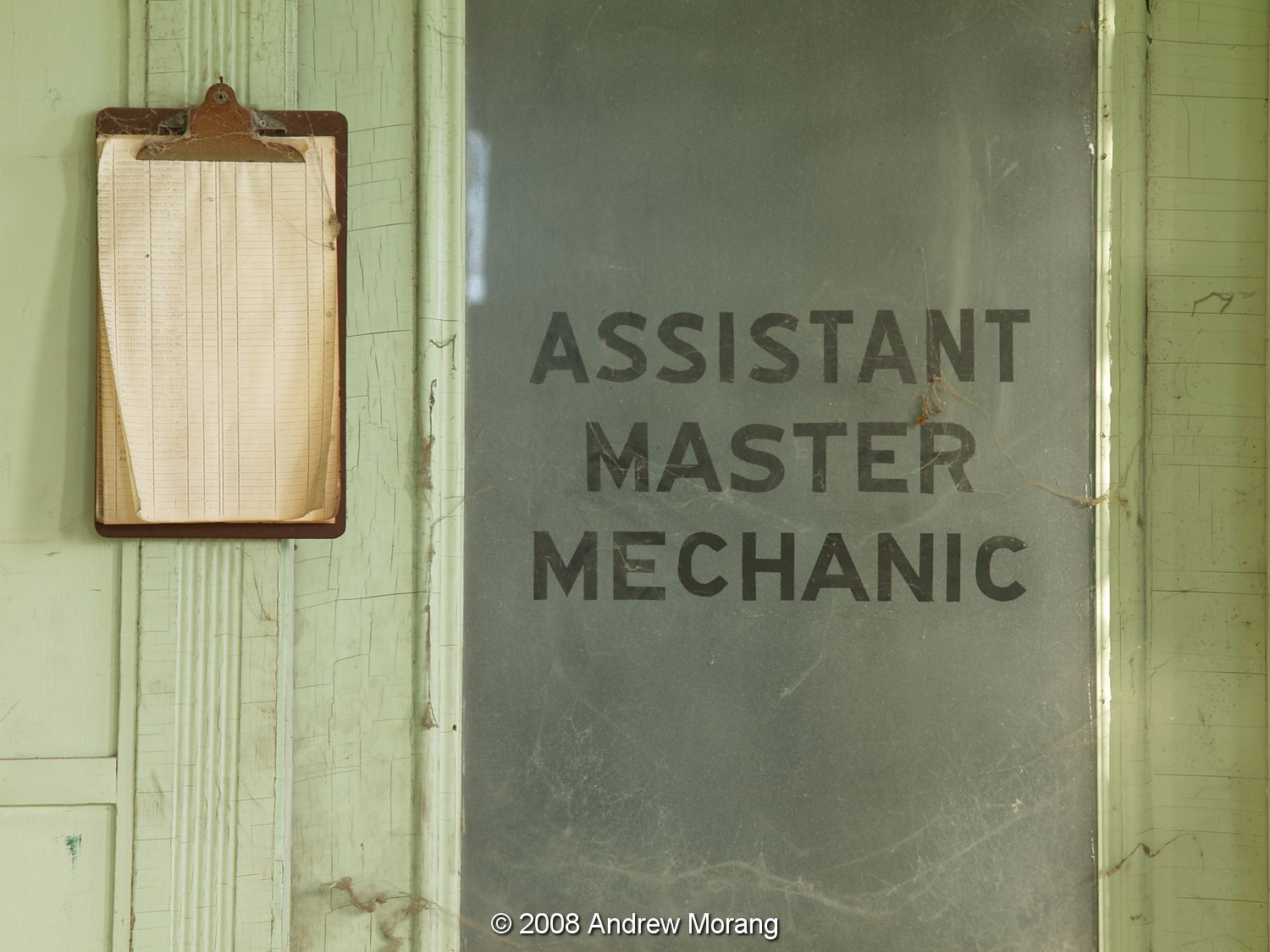
The rooms inside have old tools and furniture strewn about. I have never been able to walk inside but could take photograph through the windows.

The handcart above is the type you see in old movies where the porter takes the elegant passengers' luggage into the terminal, with dramatic lighting, steam hissing from the locomotives, and the couple smoking into each others faces (and then kissing without brushing their teeth).

Ledgers were kept in a pre-computer age.

According to the Vicksburg Post article, there are no plans to restore the building, and calls to Kansas City Southern railroad were not returned. Another piece of our heritage will soon be lost.

Finally, here is the turntable I mentioned earlier. KCS rebuilt it about 20 years ago. The old one looked like it had the original timbers and machinery from 100 years ago. I do not know how often it is used. The brick engine barn (roundhouse) would have been located about where the modern steel shed is situated. In the old days, all railroad yards needed a turntable because steam locomotives did not run in reverse as efficiently as forward. Therefore, the easiest way to turn them around was to place them on a turntable. There is less need now because modern diesel/electric locomotives run in either direction.

This the the motor and chain mechanism to spin the turntable. It had to be robust because of the weight of the locomotives. Notice the disk brake mechanism.

(2008 photographs taken with an Olympus E-330 digital camera, tripod-mounted. 2010 photographs with a Sony DSC-R1 camera. The turntable photograph was taken with an Olympus 9-18mm lens at the 9mm setting (equivalent to 18 mm on 35 mm film) on a Panasonic G1 camera.)

2014 update: I added two photographs.