 |
| Chiwong Monastery with Phaplu airstrip in the distance |
Dear Readers, this is the last monastery that my friends and I visited during our circle trek in the Solu Khumbu. The Chiwong Monastery is perched on the edge of a steep mountain - almost a cliff - with a stunning view to the south. The town of Phaplu is in the distance, and the residents of the monastery can monitor the aircraft flying up the valley, making an abrupt turn, and dropping down onto the airstrip.
Chiwong Monastery has a web page:
 The monastery has a modern guest house built only a few years ago by an Italian organization. From the guest rooms, it was a steep walk uphill to the main buildings. I do not have any pictures of the older buildings. They were hard to capture because of the steep topography, but in the first photograph, you can see the complex from the ridge top.
 This monastery also serves as a school for boys of various ages. Most eat in a group, but at every meal, 3 or 4 of the younger boys eat with the older monks to socialize them to the upper echelons of the establishment.
 We has some of the best food on our trek here. We were invited to eat with the senior monks.
The Lepon (aka Abbot) of Chiwong Gompa was a humble man who rose to that position from a village background. As a boy, he had trained at the Buddhist Academy in Serlo (described in an earlier post). His personality and personal philosophy led to his rise to the top and his approach to running a monastery full of young students. My friend, Don Messerschmidt could converse with the Lipon because both spoke village-level Nepali. The Lipon told us he had been to New York. That must have been quite a cultural and noise shock.


 As usual, the kitchen offered some interesting scenes with hard side-lighting. The middle frame of the young man washing his hands had a light leak or some bad flare.

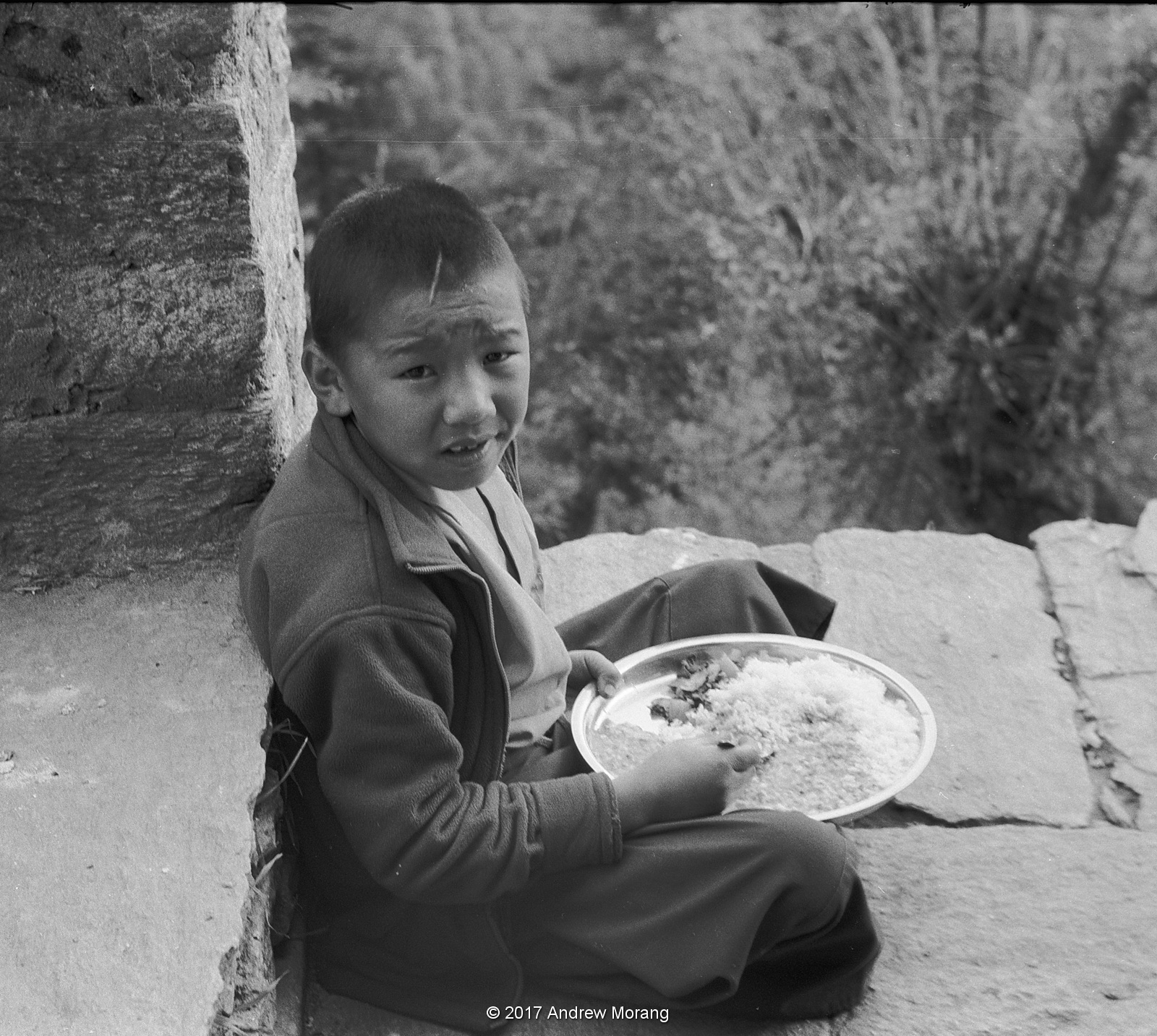
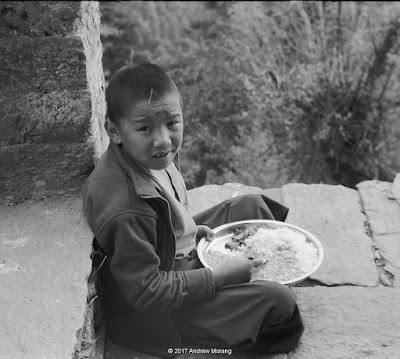 Some of the younger students had their dahl baht outside on the porch. I noticed they were using spoons rather than their fingers.
 The monastery also fed our porters. The kitchens in these monasteries are big operations, as you have seen in my various pictures from this and other Nepali monasteries.
The black and white photographs were from Tmax 400 film exposed in my 1949 Leica IIIC camera with a 5cm ƒ/2.0 Summitar lens. I used a Gossen Luna Pro Digital light meter to measure the light.
Chiwong Monastery has a web page:
The Chiwong Monastery was founded by the late Sangey Lama, in 1923. Sangey Lama’s ancestors, and all Sherpa people, have their origins in Kham, in northeastern Tibet. They migrated to the Everest region of the Solu Khumbu and made their home there, some 500 years ago.
At one time, the Chiwong Monastery echoed with the prayers and scholastic activities of the many monks and nuns that resided there. The monastery has a proud history, having been home to several spiritual leaders and learned monks. Chiwong Monastery had the privilege of hosting Dza-Rong-Phuk Sangey Ngawang Tenzing Jangpo, from 1955-1958. And, His Holiness Trulshig Rinpoche lived at the monastery from 1960-1967.


The Lepon (aka Abbot) of Chiwong Gompa was a humble man who rose to that position from a village background. As a boy, he had trained at the Buddhist Academy in Serlo (described in an earlier post). His personality and personal philosophy led to his rise to the top and his approach to running a monastery full of young students. My friend, Don Messerschmidt could converse with the Lipon because both spoke village-level Nepali. The Lipon told us he had been to New York. That must have been quite a cultural and noise shock.



The black and white photographs were from Tmax 400 film exposed in my 1949 Leica IIIC camera with a 5cm ƒ/2.0 Summitar lens. I used a Gossen Luna Pro Digital light meter to measure the light.


