Showing posts with label Vicksburg. Show all posts

Monday, May 15, 2017

From the archives: Vicksburg's Fairground Street Keystone Bridge

Photo taken on 4 ×5" Fujichrome 50 film, 75mm f/8 Super-Angulon lens.
The Fairground Street Bridge crosses over the Kansas City Southern rail yard at the bottom of the hill below Fairground Street and east of Levee Street. The bridge was open when I first moved to Vicksburg in the mid-1980s and was open as late as 1993.
There was, and still is, an abandoned tank farm at the west end of the bridge. In 1990, I went into the grounds with my daughter and we climbed one of the spiral stairs to the top of a tank. I set up my 4x5" Tachihara camera and took some exposures on Fujichrome 50 film. The tanks had open valves and nasty fumes were venting into the air. This must have gone on for years (this is Mississippi, after all). These 1990 photographs show the bridge when it was in much better condition and the access road on the west side had not collapsed. These are resized to 2400 pixels wide, so click to see details.
View east across Fairground Street Bridge, 1990, 75mm f/8 Super-Angulon lens.
My photographer friend in town let me use his Epson V600 scanner to scan the transparencies. The light platter is just wide enough to hold a film holder for 120 film, so even with the 4×5" sheets directly on the glass, about 1 cm is cut off. But I cut off excess sky, so the important parts of the scenes are present. The 16-bit color TIFF files are 220 mbytes each. Later, another generous friend gave me an Epson 3200 Photo scanner with a light cover large enough to cover the complete 4×5" transparencies.
View west along Fairground Street, 2017. A light leak in the Hasselblad film back caused the flare on the left.
Levee Street view north, 1993, 4×5" camera, Fujichrome 50 film.
At one time, the bridge was going to be moved to the Catfish Row park near the Corps of Engineers Jesse Brent Lower Mississippi River Museum (910 Washington Street), but the plan never came to fruition. So it remains at the bottom of Fairground Street, rusting and decaying. Fate unknown.
April 2017 view of the bridge from the south. Kodak Tri-X professional 320 film, Zeiss Planar 80mm lens.

Thursday, April 13, 2017

Kuhn Memorial Charity Hospital before the Fence

The City of Vicksburg finally gained legal title to the Kuhn Memorial Charity Hospital and land in late 2016. The legal battles and title searches took several years, and I can't begin to understand the details. On November 29, 2016, I was taking some photographs on Martin Luther King, Jr., Blvd., and a fence company was erecting a chain link fence to secure the property. Therefore, the following photographs may be my last of the condemned site

Severe and formal facade of Kuhn Hospital. The grass field had just been cut.
Entry main door with vandalized furniture.
West side of the hospital complex with the connector passage between the two main buildings.
Former ambulance entrance on the west side.

The interior is such a mess, I did not want to venture inside. I photographed some of the first floor rooms in early 2014 and the upper floors in 2014.

The October 20, 2016 Vicksburg Post summarized the history of the building:
A former city hospital, the city sold Kuhn to the State of Mississippi in 1956 for $5, and the state operated the facility as a charity hospital, initially known as the Vicksburg Charity Hospital, until 1989. 
The city regained the property in 1990 under an agreement with the state to turn it over to a private corporation.
In 1993, the building was considered as a possible veterans home, and in 1994, it was considered for a possible 38-bed adolescent psychiatric ward. 
In 1999, the building was sold to the Lassiter-Studdard Group Inc., which planned to open a 100-bed clinic and assisted living center. The plans fell through, and in 2000 the company donated the building to the Esther Stewart Buford Foundation. 
The property has been sold six times for taxes, and city officials have been trying for at least the past 10 years to get the property owner to clean the property and demolish or renovate the buildings on the site. 
The board on July 6 put the 12.8-acre property under the city’s slum clearance ordinance in a move to step up its efforts to remove the complex’s main building. The city’s efforts to do something with the property accelerated in the aftermath of the abduction and murder of Sharen Wilson, whose body was found on the property June 28. Police said Wilson was killed in the back building and her body left on the property, where ghost hunters who were on the site found it. When the parties with an interest in the property failed to present plans to either raze or renovate the two buildings on the site in September, it cleared the way to begin the process for their demolition.
I took these photographs on Tri-X 400 film with my Fuji GW690II 6×9 camera and its 90mm ƒ/3.5 Fujinon lens. I scanned the negatives with a Minolta ScanMulti medium format scanner operated by SilverFast software. Click any photograph to enlarge it to 2400 pixels wide.

Wednesday, April 12, 2017

2017 Revisit to the Secret Playground, Vicksburg, Mississippi

In February, I walked back through the brush to the Secret Playground off Wisconsin Avenue. The path was reasonably clear, but the playground area has a lot more brush than before. It looks like the City has not cleared or mowed since my original 2013 visit.
The merry-go-round still turns
The slide into the poison ivy thickets
These photographs are scans from Kodak Panatomic-X black and white film exposed with a Rolleiflex 3.5E camera with 75mm ƒ/3.5 Xenotar lens. I scanned the negatives with a Minolta Scan Multi medium format film scanner controlled by Silverfast Ai software.

Sunday, February 12, 2017

Margaret's Gro - Continuing Decay, Feb. 2017

Bad news on the folk art front: Margaret's Gro. is deteriorating badly. Margaret's Grocery, at 4535 North Washington Street, Vicksburg, was an amazing piece of imagination and devotion crafted by the Reverend Herman D."Preacher" Dennis. Margaret died in 2009, after which the reverend moved to a nursing home. Without his constant attention to painting and repair, his Temple to the Lord deteriorated and crumbled. Preacher Dennis died on September 4, 2012.
I occasionally bicycle to the site, and each time, the decay is more pronounced. Around 2010-2011, a group of preservationists tried to get funds to move and rebuild the temple in a protected space, but it was the depths of the recession, funds were unavailable, and the project did not proceed. Some of the sculpture and parts have been moved, but the bulk of the building is slowly collapsing.
The bus in 2014 was faded and in need of protection. as of mid-2017, it has been moved to another site for protection.
This is the grocery in 1985, about the time that H.D. Dennis married Margaret.
Only five years later, look what he had achieved. It was still a grocery, and you could buy some supplies there. But for the most part, the Gro. attracted tourists from all over the world. If any of you readers visit Vicksburg, take a look before it is gone completely.

Here are some older photographs, scanned from Kodachrome slides.

Sunday, January 15, 2017

Vicksburg Decay 2016 with Fomapan 100 Film

Mercy Hospital, Vicksburg (currently unused)

This is a three-part experiment: a new film, a commercial laboratory I had not tried before, and new scanner software (I know, I know, too many degrees of freedom).

Experiment 1: A few months ago, I read some highly positive reviews of Adox CHS 100 film, a classical fine-grain black and white film. While in Berlin last September, I stopped at Fotoimpex (a real film store) to buy some, but they were out of stock. The sales agent suggested I try Fomapan 100 Classic, a similar film made in the Czech Republic. Fomapan was established in 1921, so it has a long history of making sensitized materials for the photographic industry.

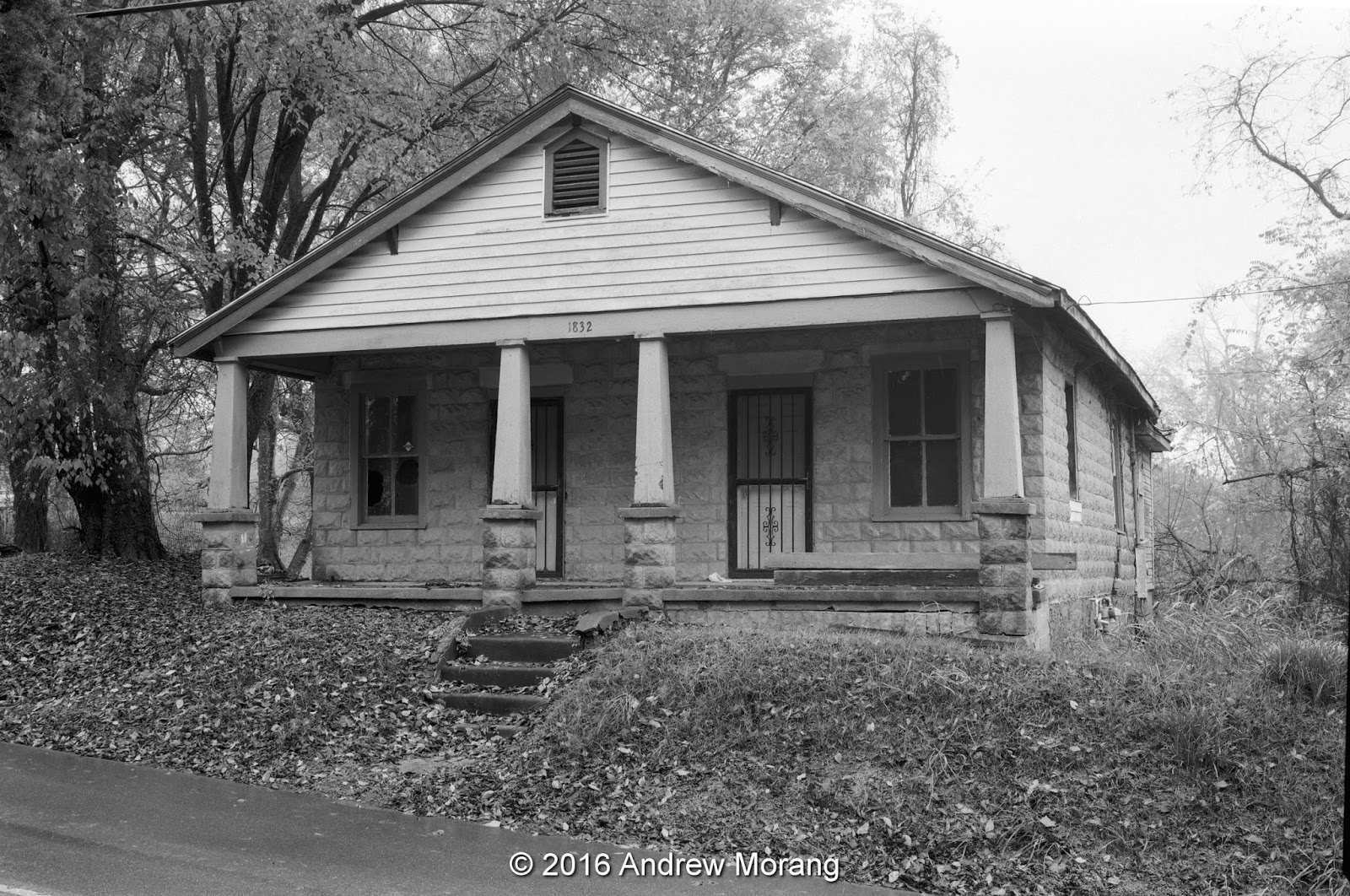
In December here in Vicksburg, during some overcast days with soft light, I tried a couple of rolls of the Fomapan in my big Fuji GW690II camera (this is a medium format rangefinder camera that takes eight 6×9 frames on a roll of 120 film). I like days with soft light when an exposure will reveal details in the shadows, such as under porch roofs. My usual practice is to overexpose and underdevelop to soften the contrast, so I exposed the Fomapan at EI (exposure index) 64.

Experiment 2: I did not have time to develop the film at home, so I sent it to Praus Productions in Rochester, New York. Praus developed the film in Xtol developer at N-1 (pull one stop), as I specified. The negatives looked pretty good, a bit dense but with full exposure range. Next time I will try EI 80 or 100 to slightly reduce exposure.

Experiment 3. The Minolta scanning software that came with my "antique" Minolta Scan Multi scanner was pretty kludgy and was low resolution on a modern big monitor. Surprisingly, the German company Lasersoft Imaging still sells a version of their Silverfast Ai software for the Scan Multi. I thought the price was outrageous, but a Christmas 25% sale made it a bit more palatable, so I bought a license for Ai. It runs on my Windows 7 computer and correctly controls the scanner. Result: major improvement over the Minolta software with far more options for film profiles. Note: many photographers use Vuscan software, but I could never get it to work well.

Zollinger's Hill Road

Results: Well, I am pleased. These are beautiful full-tone negatives. They have similar grain to Kodak Tri-X, which this reinforces the classical B&W look (which can't be simulated with software). The photograph above of Zollinger's Hill Road almost looks like the bushes are covered with frost, sort of a hidden garden. Click any picture to enlarge it and see the texture.


This is Marcus Street near where it intersects Confederate Avenue. The house is no. 1620. This was a 1/2 sec exposure at f/22, with fill flash to add some light on the tree trunk.


This cottage at 1630 Marcus Street is empty.


These steps are next to 1630 and lead down to Ethel Street. During summer, the jungle mostly engulfs the steps.


Martin Luther King, Jr., Blvd. is the former Openwood Street, leading from downtown east to the Vicksburg Military National Park. It is one of Vicksburg's older streets and is lined with historic cottages.


The cottage at 1900 MLK, Jr., Blvd. suffered a fire.


No. 1826 MLK, Jr., Blvd. is a 1920s or 1930s cottage, now empty.


No. 1832 is a duplex partly sheathed with the concrete material shaped to look like limestone blocks.

In the future, you will see more examples of this Fomapan film as well as the ever-dependable Kodak Tri-X. In the USA, you can order Foma products from Freestyle Photographic Supplies in Los Angeles. Support companies that sell film, and take pictures with film. Really, it will make you a better photographer.

Historic Foma posters are courtesy of Freestyle Photographic Supplies, Los Angeles, California. 

Wednesday, October 19, 2016

From the archives: Vicksburg in 1997 with Agfa Scala film

About 20 years ago, the venerable German photographic company, Agfa, made a black and white transparency film named Scala. It was intended to be projected, meaning to be used for black and white slides that would be projected on a screen. I tried Scala several times and liked it, but did not use it regularly. The Scala was ISO 200 and needed to be processed at a laboratory with the correct Scala chemicals. Possibly you could buy the chemicals for home use, but I never checked. Recently, I rediscovered my 1997-vintage Scala 35mm slides and did a test scan with my Plustek 7600i scanner. They looked really nice and I scanned most of the roll. Here is a semi-random tour of Vicksburg, Mississippi.
In the 1990s, three river boats regularly visited Vicksburg, the Mississippi Queen, the Delta Queen and the American Queen. All three stopped service during the economic downturn of 2007-2009. The Mississippi Queen was cut up for scrap in 2011. The Delta Queen, which was made of wood, can no longer be used for passenger traffic. But the American Queen is now (as of 2016) back in service with regular stops at the Vicksburg waterfront on the Yazoo diversionary canal.
In 1997, the Harrah's Vicksburg Casino was moored in its cofferdam on the canal side of the floodwall. The hotel was on land, but the gambling facilities had to be on floating plant. The subsequent owners of the casino filed for bankruptcy, and the barge is now moored in the Yazoo River near the Ergon petroleum refinery (I assume awaiting scrapping).
Vicksburg's famous Attic Gallery was formerly at 1404 Washington Street above Michael's Jewelry. The Gallery was a great place and packed tight with sculpture, paintings, and stuff. Attic Gallery now is at 1101 Washington Street and almost as tightly packed with interesting things.
This was the steel framing for the Vicksburg Convention Center on Mulberry Street.
This photograph shows some of the earthwork done for the convention center. The Bunge Corporation grain elevator on Levee Street is in the distance, with the Yazoo Canal beyond.
Oak Street is one of Vicksburg's older residential neighborhoods. No. 3517 is an early 20th century duplex.
Pearl Street parallels the railroad tracks. This cottage at 2521 was also a duplex and still had the characteristic split porch pillars that can be seen in many older Vicksburg houses. As of October 2016, this building is still occupied. Many other shotgun shacks and cottages that once lined Pearl Street are gone.
These almost-twin shotgun shacks are at 1300 and 1302 Harrison Street. As of 2016, they are still extant.
An old Plymouth has been parked in the garage of 920 National Street for decades. I have never seen any occupants, but someone maintains the grounds and house, so it is not abandoned.
This is the railroad cut between Belmont and West Pine Streets. I took this photograph on Feb. 3, 1997, just after an ice storm draped the kudzu and branches with ice.
This is North Fisher Street, also draped with ice.
By the time I took this picture of Letitia Street, the ice had already melted from the street.
This little church on Yazoo Street was condemned and scheduled for demolition as of mid-2016.
The cottage at 1101 Stouts Street, near the Yazoo Street church, is also gone.
Finally, we have another duplex cottage at 2729 Alma Street. The house no longer exists, and the lot has reverted to jungle.

Sadly, Agfa is gone, another victim of the digital imaging era. The company was founded in 1867 as Aktiengesellschaft für Anilinfabrikation and renamed Gevaert & Co. in 1894. Once a prominent European manufacturer of film, papers, and chemicals, Agfa-Gevaert sold their consumer imaging division in 2004 to a management buyout. But within a year, the new AgfaPhoto GmbH had filed for bankruptcy, ending over a century of top-quality film and paper manufacture. I still use their Rodinal film developer, which was invented in 1891 by Dr. Momme Andresen. Fortunately, Rodinal is still made, now by Adox, another old-line photo company. How many other 120-year-old consumer products can you buy? Freestyle Photographic Supplies in Los Angeles sells Rodinal as well as Adox and other traditional black and white films, but Scala is gone forever. Shoot more film!

All of these photographs were taken with a Leica M3 rangefinder camera, most with 35mm or 50mm Summicron lenses. I wrote about Leicas in a 2014 post.
Example of a 5-pack of 120-size Scala film. 

Friday, September 16, 2016

More tests of Tri-X film in Vicksburg and Jackson

With the return of my Fuji GW609II camera from repair (I broke it in Kingman, Arizona, on my Route 66 tour), I wanted to check if the shutter was working properly and test if North Coast Photographic's processing of Tri-X suited my preferences for contrast and "look." The following pictures are 2400 pixels wide, so click any picture to see more details.

Vicksburg


It is always nice to find a high viewpoint. This is the view looking southeast from the 10 South Rooftop Bar & Grill, which is atop the old First National Bank building at 1301 Washington Street. Most of the floors below have been converted into apartments. The big building in the distance is the WPA-era former Federal Post Office and Courthouse. For many years, Vicksburg District of the Corps of Engineers occupied part of the building. It has been empty for about 10 years and may be redeveloped. The roof in the foreground is St. Paul Catholic Church. The original St. Paul was damaged in the 1953 tornado, and this modern building replaced it.
This is the view from 10 South looking southwest towards the Yazoo Canal. The canal joins the Mississippi River in the distance. The parking garage in the right center was built in the 1970s during the "redevelopment" fad, when tearing down historic architecture and replacing it with parking facilities was assumed to be the pathway to revitalizing urban downtowns.
The Yazoo Canal runs north to the Port of Vicksburg. The road in the center is North Washington Street, which used to be US 61. Now, the official 61 bypasses Vicksburg east of the city. I used an orange filter on the three frames from 10 South to emphasize the cloud texture.
The church at 906 Yazoo Street has been abandoned for several years. The spray paint numbers mean the city engineer has condemned the structure.
Here is the same church in 1996, when it was still active. This is a 35mm Agfa Scala film frame, taken with a Leica M3 camera.
2511 Cedar Street is a condemned cottage. It is a pity; this was probably a rather nice house decades ago.

Jackson


The last two frames on this roll of film are from Jackson, Mississippi. This is the Canadian National railroad yard photographed from the Woodrow Wilson Avenue overpass. There is a sidewalk on both sides, so you can safely stand away from the traffic. These are hand-held with a yellow filter, with exposure of 1/250 sec. at f/5.65

The amount of detail in these Tri-X frames is impressive, especially if you consider that Kodak introduced the 120 film format for their Brownie No. 2 camera in 1901. The lessons of this roll: the Fuji camera works correctly. But the processing was too harsh and contrasty for my tastes. If we had overcast gloom, like Scotland, this would be perfect. The Clayton F76+ developer that North Coast Photographic uses does not seem quite right, so I will go back to developing future rolls myself in Kodak's HC110 developer.