This blog documents what remains when we abandon our buildings, homes, schools, and factories. These decaying structures represent our impact on the world: where we lived, worked, and built. The blog also shows examples of where decay was averted or reversed with hard work and imagination.
Sunday, September 3, 2017
Lost Victorian House: 1210 Finney Street, Vicksburg, Mississippi
But there was scaffolding around the porch and some timbers had been replaced. We hoped it could be saved. These old houses can endure decades of neglect, but once the roof begins to fail, water causes rot.
Bad news. On Saturday, September 2, 2017, I bicycled along Drummond Street and saw the trucks on Finney Street. A demolition crew was at work smushing the Victorian house and loading the timbers and debris into trucks. Was it not worth deconstructing it to save 100+-year-old joists and flooring? Well, that is how we lose our architectural heritage along with irreplaceable virgin timber wood beams.
The square photographs are from a Hasselblad film camera with the 50mm Zeiss Distagon lens, using Kodak Panatomix-X film. The last picture is from a Nexus 4 telephone (sorry, no room for the Hasselblad on my bicycle).
Thursday, August 31, 2017
Metal-Shingled Gasoline Station, Claude, Texas (Texas Panhandle 01)
Claude is a small town southeast of Amarillo. We were zipping through town and this little gasoline station caught my eye. Look at the roof tiles: they look like clay but are really steel with (probably) a zinc coating.
Under the overhang, the original zinc ceiling panels are still in place. You still see these in early-20th century commercial buildings, and recreations are available for places that want to replicate the old-timey look.
Inside, a resident! I suppose the gas station attendant is still awaiting customers.
I have seen these zinc roof tiles before. This is the old Tallulah (Louisiana) Terminal, now known as Scott Field. This handsome little terminal was on the original routing of Delta Airlines in the 1930s.
This is a close-up of some of the tiles, photographed from the second floor. Nice workmanship. I am surprised we do not see these types of metal tiles used more on current construction.
An article by Thomas Rosell in Preservation Mississippi provides some advertisements from companies that made metal shingles. Many were from the Montrose Metal Roofing Company of Camden, New Jersey.
The 2017 photographs are from a Fuji X-E1 digital camera. The 1991 is a Fuji Velvia slide taken with a Leica M3 camera and a 50mm ƒ/2.8 Elmar lens (the superb 1960s and 1970s version with lanthanum glass and an almost circular diaphragm).
Monday, August 28, 2017
The Valentine Diner of Chandler, Oklahoma
On our recent Route 66 trip through Oklahoma, we passed through the small town of Chandler. I stopped to photograph a historic Phillips 66 gasoline station on the corner of Manvel and 7th Street. My always-observant wife looked down the street and told me to check out an old diner. A real find!
The inside was a mess, and the counters were gone. But you can see the streamlined pseudo-Art-Deco stripes on the overhead cabinets. Nice work.
Viewed from the other side, you can see there was once a fire. There was no sign of restoration in progress. But at least the windows were intact.
An article on diners in Preservation Mississippi directed me to the Kansas Historical Society, which has a page dedicated to these efficient, compact diners.
From the Kansapedia of the Kansas Historical Society:
"What are Valentine Diners? They are small, portable restaurants that were made in Wichita and shipped all over the United States."
"Valentines were small eight- to 12-seat diners with a limited menu, making them ideal for a one person operation. They made it possible to operate a business with very little capital. "
"These diners were manufactured in Wichita from the late 1930s into the mid-1970s. Sales of the buildings expanded nationwide, and soon Valentines were all over the United States. Many are still in use today. "
- "History: A 1958 Valentine that originally was located in Leedy, Oklahoma, this diner was purchased by Patina Properties in 2003 and moved to Chandler. It currently is being restored.
- Model / serial number: Little Chef / 1690"
Friday, August 25, 2017
Abandoned Fuel Terminal, Mulberry Street, Vicksburg, Mississippi (in film)
| Kansas City Southern tunnel under Washington Street, Vicksburg |
![]() |
| 1898 keystone |
One building had piles and piles of old invoices and receipts. I guess this is the paperless office we hear about so often.
I revisited the terminal on a sunny day spring 2017 when I was testing my newly-acquired Hasselblad. These three are with Tri-X 400 film. Not much has changed. There is still a faint aroma of petrochemicals. Mississippi is easy for this type of photography because many abandoned sites are unlocked and open.
The horizontal photographs are from a Fuji GW690II 6×9 medium format rangefinder camera and Panatomic-X film. The square photographs are from a Hasselblad 6×6 camera with a Zeiss 80mm f/2.8 CB lens using Kodak Tri-X 400 film.
UPDATE APRIL 7, 2018: The pumps, valves, and metal stands are gone. The site is covered with new soil and gravel.
Saturday, August 19, 2017
The Mississippi Delta 23: Morgan City
The main road through town, Hwy. 7, has an agricultural complex, but I could not tell if it was in operation.
I took these photographs with my Fuji GW690II 6×9 camera (medium format, known as the "Texas Leica") with its 90mm f/3.5 Fujinon lens on the classic Kodak Panatomic-X film (long discontinued). I wrote about Panatomic-X in an earlier post (click the link).
Tuesday, August 15, 2017
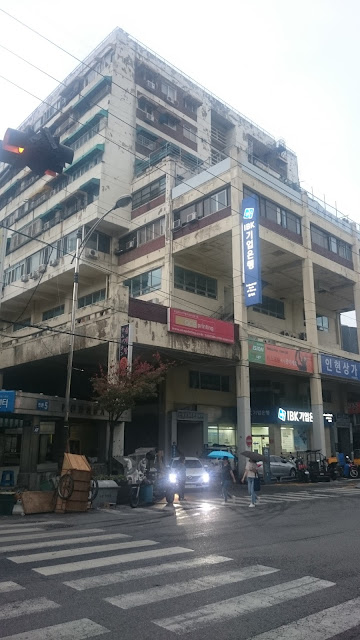
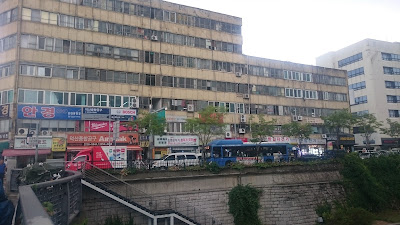
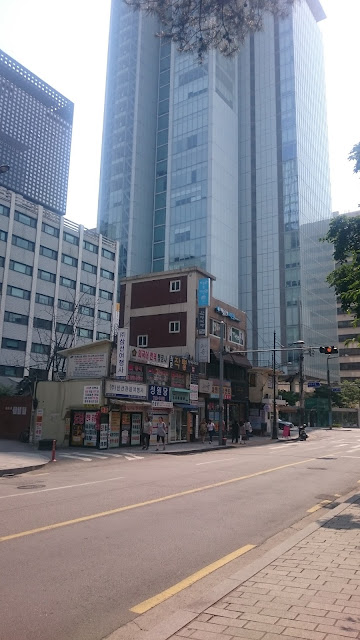
Ugly Buildings in Seoul, South Korea
Kodachromeguy asked me to contribute a post to his urban decay blog after my recent trip to Seoul, South Korea. Seoul isn't decaying. Very much not so! But it's a very ugly city with a lot of very ugly buildings. Hopefully readers of this blog will enjoy my photos (which undoubtedly don't match Kodachromeguy's usual quality standards) and my descriptions of Seoul.
Today, the Seoul metropolitan area is home to about 25 million people, which is about half the population of South Korea. (For comparison, the greater Los Angeles region, a geographic area far, far larger than Seoul, has only about 15 million.) The Korean people picked themselves up by their bootstraps after the Korean War (1950-1953) and went from being one of the world's poorest countries to being one of the richest in just 50 years or so, transforming into a world leader in technology and culture with a very high standard of living.
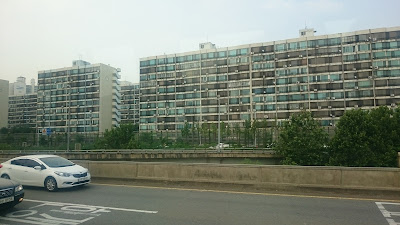
Despite this impressive development record, Seoul is a very ugly city. The city is densely packed with nearly-identical high-rise apartment blocks and a mish-mash of other concrete rectangles, very few of which seemed to have benefited from the services of an architect. The city functions very, very well, and efficiently, but it's certainly not inspiring to look upon.
| View from the historic Seoul City Wall on Inwangsan Mountain showing vast swaths of identical high-rise apartments. |
Modern Seoul was built in a hurry. Some 1.2 million people died in the Korean War, a conflict which obliterated a great deal of infrastructure and left the country divided. After the war, massive amounts of housing and other basic infrastructure were the top priority. The following decades also saw large amounts of rural-to-urban migration, spurning on the need for still more rapid building. It's no wonder there was little room for aesthetic considerations.
These quickly-built, now-older areas of the city have some really awful beat-up buildings, all still in use. (There's no room in Seoul for empty buildings or vacant lots. Every inch of space is used.)
| Possibly the ugliest building I've ever seen (Myeongdong, central Seoul) |
| A wholesale market building down the street from the Dongdaemun Design Plaza |
| An older neighborhood "ripe" for gentrification, across the tracks from the brand new Digital Media City development |
| From the same neighborhood |
| Believe it or not, these lovely apartments have a gorgeous view of the Han River! |
That said, some of the newer areas do look a little nicer. For example, Digital Media City, a government development project to put media and entertainment companies in a sparkling new neighborhood, had some buildings that looked like they had actually been designed and some top-notch public art.
The stream begins with a fountain and a little artificial waterfall right in the city center and then travels in a nicely-landscaped concrete channel for several miles before emptying into the Han River. Either the historic water source of the stream was always intermittent, or else it's been too disrupted by other construction (of the metro and such) to provide adequate water for the stream now, so Han River water is actually pumped to supply the stream water. It's fantastic as a park, and it's beautiful, but its ecological value is debatable. It's certainly not "natural", but it's also probably a lot better than a highway.
| The restored Cheonggyecheon Stream near Dongdaemun |
Sunday, August 13, 2017
The Mysterious Moving Phillips 66 Station, Adrian, Texas
I checked the locations of these buildings on Google Maps and was perplexed. Look at the Google Street View from 2011: The little station is not present. Someone trucked in this the little building from somewhere else and placed it next to the tree. Did the aliens move it?
Wednesday, August 9, 2017
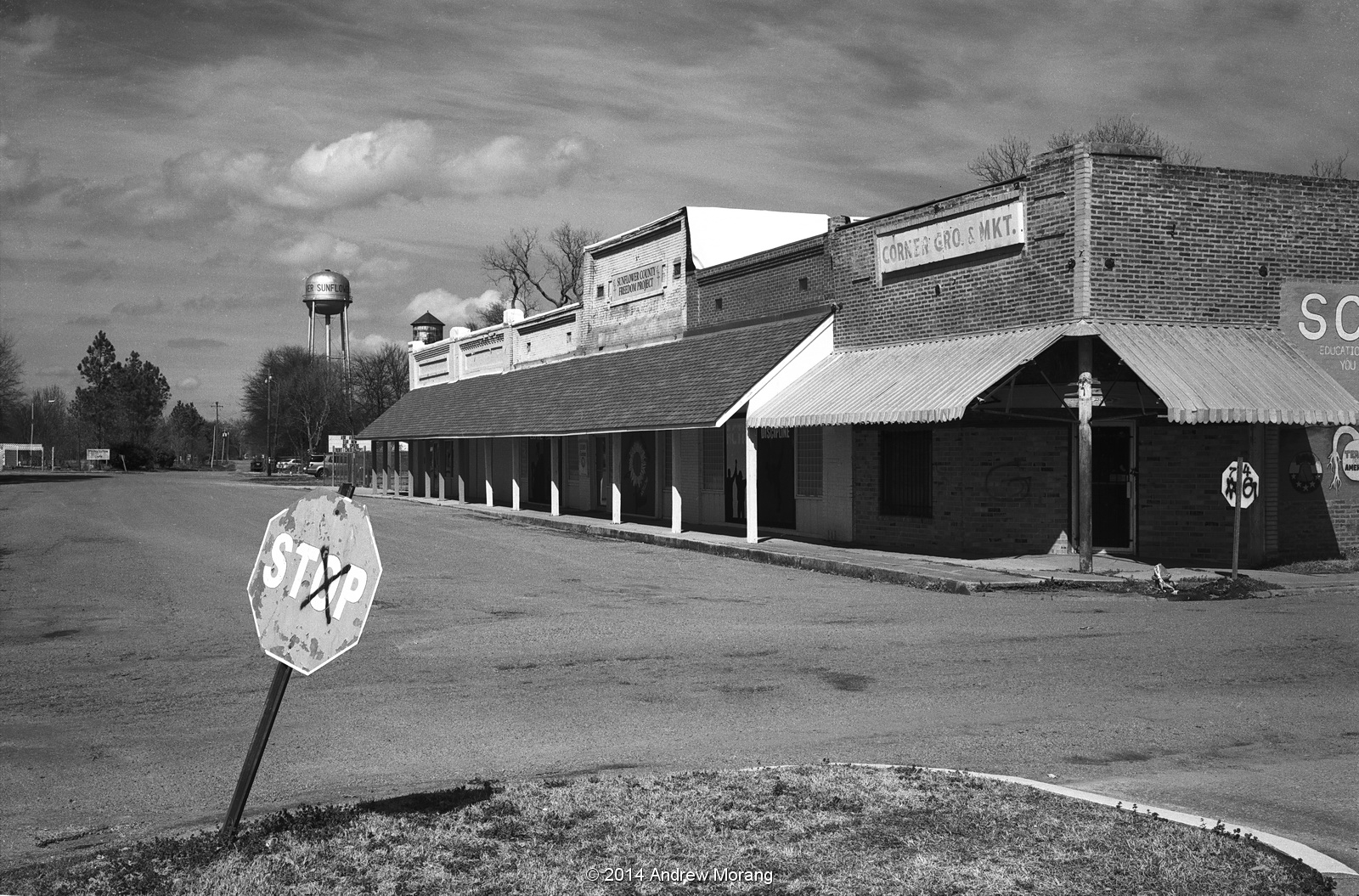
The Mississippi Delta 22: Sunflower
![]() |
| Sunflower playground - where are the children? |
Delta Ave. was the former commercial block, consisting of brick shops similar to those in other Delta towns.
Russell Grocery on Quiver Street was open. The proprietor generously let me take a couple of photographs. He said he was doing his best to keep the store in operation. It was immaculately clean. I noticed that most of the food was in the form of fast food and soft drinks - the curse of the Mississippi diet.
Other grocery stores had occupied the building in the past.
At Haley's Floral Center, also on Quiver Street, the ladies invited me in and showed me some of the floral arrangements. They were very gracious. Such kind people, but it must be a difficult life in a small town. What can they do professionally other than move away? But that inevitably would mean mean leaving family behind.
The first two photographs were taken with a Fuji GW690II camera on Kodak Panatomic-X film. The remaining photographs are from a Fuji X-E1 digital camera.
Monday, July 31, 2017
The Mississippi Delta 21: Drew
Drew is a small agricultural town in Sunflower County. It is just off US 49W, between Tutwiler and Ruleville. I have been to Drew twice and both times was impressed by the grain elevators and symbols of its agricultural prosperity (or former prosperity), and unimpressed by the general state of decay and impoverishment.
Front Street parallels the former Yazoo and Mississippi Valley Railroad (Y&MV) line. Many of the elevators were built next to the tracks.
During my 2017 visit, there was a heavy but brief rain, after which the light was sublime.
The corrugated steel lends a lot of shape and texture to photographs. These old elevators were impressive scale, and now they sit unused. The buildings were closed and I did not want to try to get in as I was alone.
On Union Avenue, I came across an abandoned store with one of the 45° entryways that you often see at corner shops. There was a Teddy Bear nailed to the power pole out front. I stopped and set up my tripod. Two young ladies with extreme cleavage stopped their car and seemed amazed to see me photographing. When I said I was interested in the Teddy Bear, they said it was a memorial because a guy was shot there a few days before. It is grim that violence is such a defining characteristic of life in many communities.
East of town, Hitt Chapel on Rte. 32 sits quietly on its own in the farm fields. The peacefulness is such a contrast to the troubles that exist downtown.
Most horizontal photographs were taken with a medium-format Fuji GW690II camera, the square with a Rolleiflex 3.5E with Xenotar lens. The film was the long-discontinued Kodak Panatomic-X. These negatives were scanned on a Minolta Scan Multi medium format scanner using SilverFast Ai software. The photograph of Hitt Chapel is from Kodak BW400CN film and a 35mm Pentax Spotmatic Camera (purchased in 1971 and still in operation).