Showing posts with label Xenotar. Show all posts

Saturday, January 3, 2026

On the Waterfront: Harbor Days in Olympia (Oly 24)

Dear Readers, Happy New Year to you all! I hope 2026 is prosperous and healthy, and thank you for reading along.


Olympia really likes its waterfront! Harbor Days is a three-day festival of boats, food, children's' activities, sunshine, and antique tugboat races. A good time is had by all. Here are some pictures from the 2024 festival.


Percival Landing, Olympia (Tri-X 400 film, Rolleiflex 3.5E camera)
WWII era tug Commanche (the large vessel)

The Comanche is a sturdy old World War II navy tug, launched in 1943. I want onboard before the start of Harbor Days and spent an hour listening to two former crewmen relate stories. She is owned by the Comanche 202 Foundation in Tacoma. I do not know how far around Puget Sound she travels. This old-timer needs a lot of maintenance and overhauling. When young, she was powerful enough to tow aircraft carriers in the Pacific Ocean.


Where is the concert? (Fuji X-E1 digital file)
Lego artists of budding marine engineers


The commercial part of the Port of Olympia offered short tours for the public. Normally, the Port is a restricted area, so a guided tour promised to be very interesting. It was! The Port of Olympia's most common cargo now is lumber. Huge logs come into town on 18-wheeler trucks. They are sorted and labeled at the port and then loaded onto freighters. Most go to Japan and Korea. Every log has a label indicating its quality. Rarely, a cattle freighter takes cows to Vietnam. 


Machine for unloading logs from trucks
Serious forklift
Shuttlewagon - runs on rails and pavement

I took these photographs with a Rolleiflex 3.5E camera with 75mm ƒ/3.5 Xenotar lens (5-element version) on Kodak Tri-X 400 film. I scanned the negatives with a Minolta Scan Multi film scanner operated by Silverfast software on a Windows 7 computer. I cleaned chemical blobs and dust with Photoshop CS6.


Monday, March 11, 2024

Olympia with Fuji NPH400 (Abandoned Films 12) (Oly 03)

Dear readers, we will continue our irregular series on Olympia, Washington. 

Moving to a new home in a new state was quite an adventure. Closets and boxes in our former home revealed all sorts of treasures (much of it junk). How did we accumulate all this stuff? Is this the curse of American suburbia? 

But I found some goodies. The depths of the freezer disgorged a box of 120 size Fuji NPH 400 film. The box expired in Feb. 2005. The last time I used a roll may have been in 2018, when I drove to Asheville, North Carolina, to The Vintage car show. Six years later, was it this NPH still viable? 


Being a 400 film, I thought it would be useful for hand-held work with my Rolleiflex, which has a ƒ/3.5 lens. One drizzly January morning, I walked around west Olympia while waiting for car repair. 


Eagan's Drive-In, 1420 Harrison Avenue - not yet open for the day
Eagan's toilets, maybe not available today
The dancing burger, Eagan's Drive-In
Division Street view north
Taco trucks ready to roll, Harrison Avenue

I took the Rolleiflex out on a cheerful sunny day. The NPH film responded much better.

Swantown Boatworks, Marine Drive NE 

Conclusion: Semi-success, this long-expired NPH 400 was still viable. But some of the frames were slightly underexposed, some more extreme. My Luna Pro light meter is working correctly because other rolls of film from 2024 are properly exposed, frame after frame. Could this old NPH film be more sensitive to reciprocity failure because of its age?  (Reciprocity with camera film means that the film sensitivity is not linear over a standard light range. Therefore, darker scenes need more exposure than a light meter might indicate.) For this roll, I set the Exposure Index at 320, but next time, I will use EI=200 or even lower. Regardless, it is time to use it up. Even frozen, it will not last forever.

Thanks for enduring another adventure in expired camera film. 


Saturday, April 29, 2023

From the Archives: Washington Avenue, Houston, 1981 (TX 09)

In the long-ago earlier life, my wife and I moved to Houston, Texas, in 1980. The big city! There was so much to see and explore! 

Having a real job and some income, I bought a used Rolleiflex 3.5E camera at Southside Camera Center (long gone). What do you do with your first medium format camera? Well, start looking for interesting urban decay. Back then, Houston was full of grunge and decay. (Some critics say Houston is still full of grunge, but we better attack this issue now.) As you long-term readers can see, I have been doing this decay topic for a long time. 


My 1956 Rolleiflex 3.5E camera with its superb 75mm ƒ/3.5 Xenotar lens - why did I stupidly sell it when I though digital might be the next great thing?

Washington Avenue runs approximately east-west out of downtown Houston, Texas, through the former Sixth Ward. Washington Avenues in US cities are typically older streets that run through well-established and often run-down neighborhoods. This one fit the pattern in 1981. Here are some samples. Please click any frame to see it enlarged.


Turney Motor Company occupied a 1920s gas station building. You could drive a Chevrolet Nova for $35/week - it says so!

The building is gone, and the lot provides parking for the trendy Ivy House cocktail bar next door. Washington Avenue was not very trendy in 1981....

Houston Junk, now possibly Rose Recycling on Center Street
Time for a 50¢ beer, corner of Center and National Streets
Historic 1872 Glenwood Cemetery, an oasis of green and peace in the city
June 1980 view of Houston from Glenwood Cemetery (Kodak Panatomic-X film, Nikkormat FTn camera, 28mm ƒ/3.5 lens)
Early 20th century brick commercial building, 1722 Washington Avenue 

In the mid-20th century, all American cities had commercial buildings of this type. The families who ran the shops or small businesses often lived in apartments on the second floor. White flight to the suburbs after World War II destroyed many traditional and mixed inner city communities that would have depended on local shops in such buildings. 

This building is gone and a modern town house/condominium is in its place. At least in Houston, the cycle is turning and professionals are returning to live within the city. 

Early 20th century wood cottage Washington Avenue. 

This was one of my early examples of photographing dilapidated houses. This building is gone, probably demolished years ago. A large framed print of this scene has hung in my house for four decades, but the print has changed colors and faded.  


This handsome old fire station is still extant
Gent with his laundry, 1712 Washington Avenue

This is another example of an early-20th century commercial building. Note the formerly handsome tall arched windows. The lower floor had ventilation transoms. 

I took these photographs on 120-size Kodak Vericolor II Film with my Rolleiflex on September 5, 1981. The colors are a bit muted, but all in all, the film survived the decades quite well. In those days, you could buy 120 film in many camera stores, but professional emulsions, like Vericolor II, came from larger stores with a film refrigerator. This roll probably came from Southside Camera Center on Bellaire Blvd.

Thank you for joining me for this look back to 1981. I also wrote about Main Street in 1982 (click the link).

Saturday, February 11, 2023

Verichrome Pan Film in Mississippi and Louisiana (Abandoned Films 06b)


In 2020, my friend from Indiana sent me a roll of the long-departed Kodak Verichrome Pan film in 120 size (for medium format cameras). I used it on a snowy day in Vicksburg in early 2021 and loved the results. It was high resolution and just perfect for my type of photography. I never tried Verichrome Pan when it was in production, but now I wish I had. 

I have had surprisingly good results with discontinued black and white films such as Kodak Panatomic-X and GAF Versapan. But it is always a gamble with expired film and I decided to only buy fresh product from now on. Well, as you can guess, I was unable to stick to my own advice. A seller on eBay claimed two rolls of Verichrome Pan had been frozen for years, so I succumbed to temptation.

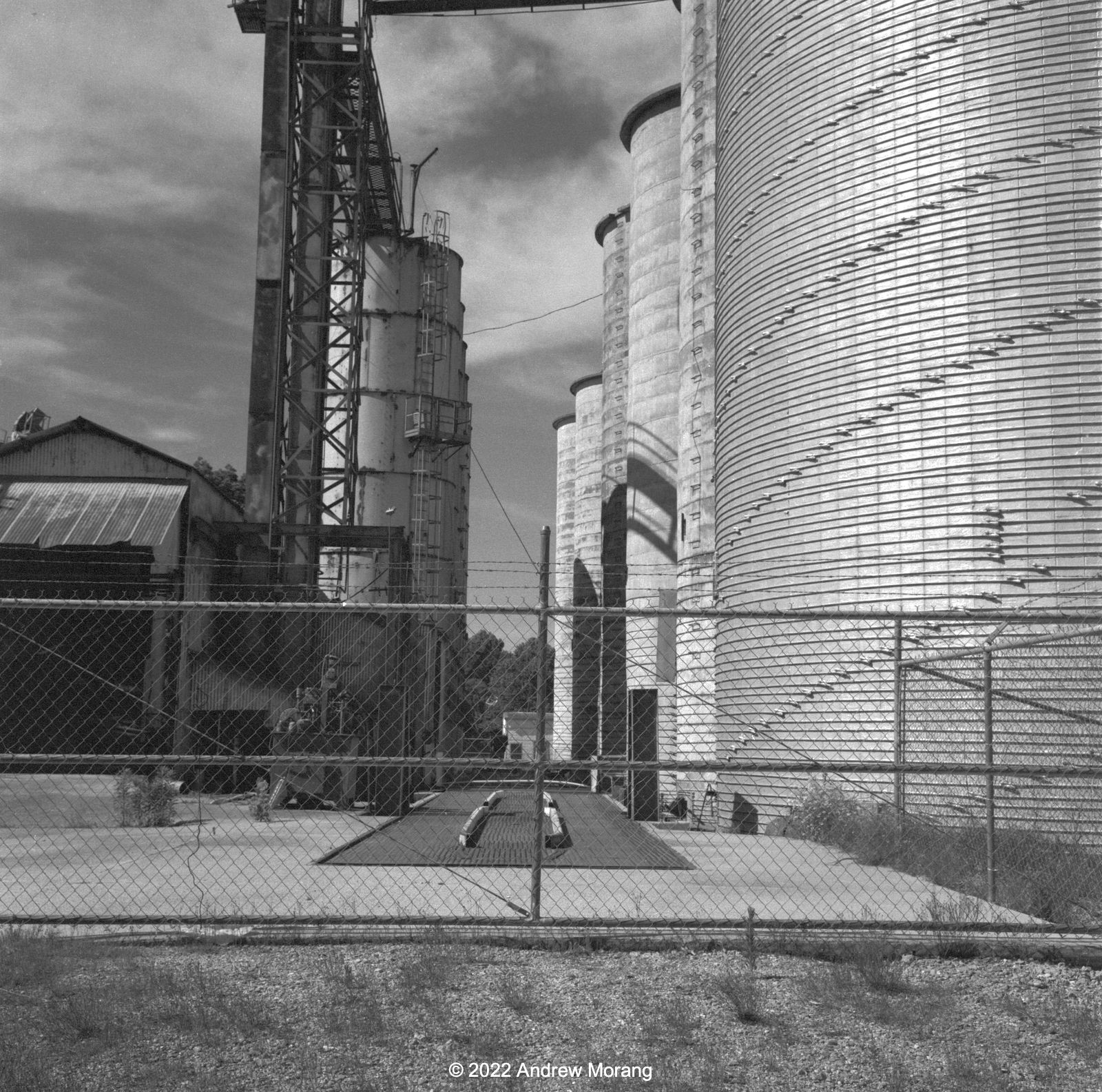
Of the two rolls, the first was perfect. The other was so thin, it was useless. That is the risk of buying expired film. I used that first roll in the Mississippi Delta on a blazing hot June day with harsh and unforgiving light. The camera was my Rolleiflex 3.5E with its 5-element 75mm ƒ/3.5 Xenotar lens. Even today, this 1959 camera is totally usable and optically excellent. Used Rolleiflexes in good condition sell for serious $$s on eBay or via auction houses now. Click any photograph below to see it expanded.


Louise, Mississippi


Louise is a small agricultural town in Humphreys County west of Yazoo City. It consists of a small core of houses with silos and former shops along Main Street. It may have been busy decades ago, when the railroad ran through town. But today, it is forlorn.


Main Street view north, Louise, Mississippi (1/30 ƒ/11, Rollei orange filter)
Main Street, Louise
Silos (1/15 ƒ/16, orange filter)
Main Street stores, Louise (1/30 ƒ/16, yellow filter)
Lee Hong Grocery, Louise (1/60 ƒ/11.3, yellow filter)
Quiet afternoon in Louise


Yazoo City, Mississippi


Yazoo City was the "Gateway to the Delta." It is still a busy town with a harbor on the Yazoo River. Timber is a major product. But the town is a bit rough.


Fixer-upper store, West Broadway, Yazoo City (1/60 ƒ/11.5, yellow filter)
Garage and gin, 301 West Bridge Street (1/125 ƒ/8, yellow filter)


Tallulah, Louisiana


The last stop on our Verichrome Pan trip is Tallulah, Louisiana. Tallulah is just off I-20 about 20 minutes west of the Mississippi River bridge.


Former Tallulah High School, Bayou Drive (1/30 ƒ/11.5, orange filter)

This was a blazing hot (95º + F) afternoon with harsh sun. I had one frame left and stopped at the old Tallulah high school. Much of the roof has collapsed, but the brick walls remain. The ball field to the left out of the picture view is still in use. It is sad that these handsome brick buildings are abandoned.

This ends our short Verichrome Pan tour. I probably should have dialed back from the orange filter to deep yellow or just plain medium yellow. Internet users claim that Kodak's discontinued Plus-X film was very similar in tonality and grain. My friend will send a couple of rolls of 35mm Plus-X for me to try. I'll post the results later.

Note: some film users on the internet believe the new Kentmere 100 in 120 size looks much like Verichrome Pan. I need to try it. Kentmere is made by Ilford, and the 120 size is a recent (early 2023) introduction. 

Tuesday, October 27, 2020

Architecture from our Industrial Past: Bates and Androscoggin Mills, Lewiston, Maine

Undated post card showing Bates Mill and canal, Lewiston, Maine (from Wikimedia)
Outflow canal, Upton Mills, Mill St., Lewiston (Kodachrome 64 film, Rolleiflex camera, 75mm lens)

Northern New England (USA) is full of former mill towns with amazing 1800s brick mill buildings. Most of these were built in the early- to mid-1800s on rivers, where water power could power the machinery. Most of these mills spun cotton or wool into textiles, while other factories produced shoes. These industries represent the early flourishing of the industrial revolution in the United States. 

The New England States and northern New York provided a perfect geology for our early industrial expansion because of the steep terrain, dependable rainfall, and hard rock geology. Rivers flowed down over numerous waterfalls where water wheels could be placed and a factory established. Flowing from hard rock terrain, the rivers flowed clean, and hydro projects were not plagued with silt and mud accumulation. Bustling towns grew up around these factories. Being close to the coast, merchants shipped manufactured textiles and other goods to ports like Portland, Portsmouth, Boston, or Providence for transshipment to Europe.

1910 photograph of the Androscoggin River (from Wikimedia)

Lewiston is the largest city in Androscoggin County, Maine. This part of Maine was populated by Quebec families and was incorporated as "Lewistown" in 1795. With the development of mills and the arrival of the railroad, the town boomed economically during the mid-late 1800s, attracting thousands of Quebecers to migrate. French is still commonly spoken. 

The textile industry's profits declined greatly after World War I. Starting in the 1950s, Lewiston's mills started to close (an example of early outsourcing, where textile companies shifted manufacturing to the US South, where labor was cheap and non-unionized). 

The status of these huge mill buildings has been fraught with economic and historic preservation issues. According to Wikipedia:

After a difficult economic period in the 1980s that saw high unemployment and downtown stagnation, several key events have led to economic and cultural growth, including the transformation of the historic Bates Mill Complex. Because the city took over the complex in 1992 after back taxes went unpaid, years of taxpayer frustration in the city's need to maintain the 1.1-million-square-foot (100,000 m2) behemoth led to two referenda (one non-binding vote, the other binding). Voters soundly supported the need to pursue redevelopment by maintaining the property and selling it to private developers. In 2001, the city sold three mill buildings to local developers. In 2003, Platz Associates sold the Bates Mill Complex, with the exception of Mill 5 and a small support building. For the next four years, a number of business enterprises expanded after Platz redeveloped the mill building. The Bates Mill complex was listed on the National Register of Historic Places in December 2010.

A relative who lives in Lewiston knew the manager of one of the redevelopment projects. His foundation intended to find new tenants for one of the magnificent old Bates Mill buildings. She made the connection and we all had the chance to tour the building and learn about the development plans. He generously let me take photographs inside.

Bates Mill #1 or #5, Canal Street, Lewiston (Ilford XP2 film, Rolleiflex 3.5E Xenotar, 1 sec. exposure)
These views of the cavernous halls give you a sense of the size of this building. Iron posts support huge timber joists, and the tongue-and-groove flooring felt solid enough to support tons of machinery. This was construction from an era when we were proud of what we built, and it was made to last decades.
This photograph shows how the iron posts hold up the ceiling joists. The fluorescent light fixtures would have been a post-World War II addition. The outer wall were brick bearing walls.
Sink for workmen (or ladies) to clean up
Hot water boilers
Former cooler or freezer (unknown purpose)
What an impressive building. I could spend hours wandering around and photographing the structure. The machinery had been removed long before we were there, and none of it was left.
Undated photograph of Androscoggin Mill, photographed by Drew & Worthing, 22 Tremont Street, Boston (from Historic New England, photograph number OVP0241)
After our tour, I drove a short distance west to the old Androscoggin Mills. At its peak, this was another massive complex of buildings, roads, and canals. I do not know how many of the buildings are still standing or which one I tried to check out. The one I approached was locked, but several out buildings were open or partly collapsing.
I tried the door, but it was jammed or locked. And the signs of a security service were a bit ominous.
Heat exchanger? Power House, Androscoggin Mill, Lewiston
Boiler in power house, Androscoggin Mill, Lewiston
This has been a very short tour of the two of the mills in Lewiston, I have more photographs from other towns along the Androscoggin River, but I need to scan them. Some are 120 size Kodachrome transparencies, which are mounted and do not fit in my scanner. A project for the future...

The black and white photographs above are from Ilford XP2 film exposed with a Rolleiflex 3.5E camera. I exposed the film at EI=400. Most exposures were 1 sec. long, and I placed the camera on beams or furniture to brace it. The XP2 has a long tonal range and is very sharp, perfect for this type of subject matter. Problem: when I recently looked at the negatives, they were deep purple color and seemed to be fading. Possibly the film had not been fixed properly. I decided to scan them before they deteriorated further. This is a chromogenic film (like color print film but monochrome only) and is usually considered to be less stable than traditional silver-based black and white film. 

Wednesday, October 21, 2020

Lost to Fire: Powers Country Store, Grangeville, Louisiana

In early 2017, I visited the extremely interesting Laser Interferometer Gravitational-Wave Observatory (LIGO) in Livingston, Louisiana. This is the research facility that helped confirm the existence of gravitational waves. A similar laboratory is in Hanford, Washington, and the two confirm each other's observations. On my way home, I drove west and north on the way back to Mississippi. Passing through Grangeville, I saw Power's Country Store on LA 37. Quick stop. The proprietor generously let me take some photographs inside with my Rolleiflex. This was one of these handy stores that sold munchies, drinks, hardware, and various other supplies. It was active with customers coming and going.

The outside looked like an old building with many additions over the years. Its not possible to tell what was there in the late-1800s.
The steps led to the part of the store with hardware, seed, and feed

The inside was a fascinating look at an older time. Mounted deer on the walls. Miscellaneous snacks and groceries. Tools, seeds, and automotive supplies on a higher level. Bare light bulbs and fluorescent tubes - nice stuff. Old-timers, bubbas, and children milled around.

These interior scenes were 1-second exposures on Kodak Tri-X 400 film, tripod-mounted. I used a Rolleiflex 3.5E with 75mm ƒ/3.5 Xenotar lens. I bought some cold juice, thanked the folks at the counter, and headed home.

I forgot about these negatives and did not scan them until July of 2020. Then I looked for information about Powers Country Store and was horrified to learn that it burned down on June 26, 2018, only a year after I visited. From WAFB 9 (Baton Rouge):
GRANGEVILLE, LA (WAFB) - An old neighborhood grocery store that has been a staple in St. Helena Parish for more than a century is gone. Powers Country Store in Grangeville was destroyed by fire Monday night. 
Flames shot nearly 20 feet into the air as firefighters battled the massive blaze at Powers at around 10:30 p.m. Cell phone video taken by someone who witnessed the destruction spread quickly on social media, perhaps because the old store holds a piece of rich history. It has been open since 1896. An old, rusted sign bearing the store's name and the couple, Frank and Ramona, that started a restaurant some 60 years ago is all that remains.
From The Advocate (Times-Picyune, New Orleans):
Until the fire, the Powers Store remained a vibrant place for people living and working in the area, including the local gravel pit workers, Graves said.

“Usually at lunch time the parking lot is packed,” Graves said. “Now I don’t know what they’re going to do, I guess go to the truck stop a little farther south. It is going to really sting not having it there.”

Suzanne Hornsby Hobgood was among several people who stopped by Tuesday to extend condolences. She said she remembered buying candy from Frank and Ramona Powers when she was a kid. As an adult, she brought her family to do the same.

“I’d come out here and bring my children. And now I’ve been bringing my grandchildren,” she said.

Hobgood said the store was filled with history, including an antique cash register, deer mounts from hunting trips and old photographs. 
I am sad; this is how we lose out cultural heritage. As time goes by, people forget. Within a few years, almost no one will remember that Powers Country Store once existed and served the community.

Older Urban Decay articles about country stores (please click the links):

Lorman, Mississippi
Lorman, Mississippi in 2019
Farnham, Virginia
Roy's Store, Chatham, Mississippi
Onward, Mississippi
Learned, Mississippi
Betigheimer Store, Edwards, Mississippi
Willis Store, Edwards, Mississippi
Yates Store, Utica, Mississippi
Twin Arrows, Arizona (Route 66)