Showing posts with label Mississippi. Show all posts

Monday, February 1, 2016

Into the Woods: the Kiln Colored School, Kiln, Mississippi

Before a recent trip to the Mississippi Gulf coast, I checked the Mississippi Heritage Trust's list of most endangered sites. The Jourdan River School, formerly Kiln Colored School, was on the 2015 list and was easy to reach by driving north from Waveland.
The building is in the woods just east of Mississippi 603, north of the junction of 603 and the Kiln-Delisle Road. At first, I did not know where to look, but the town's dispatcher pointed out where to stop the car and look through the trees. According to the Heritage Trust, loggers uncovered the school when they were cutting timber. Although the site was cleared, brambles and weeds are growing rampant. I predict that after one more growing season, you will be unable to reach the school unless someone clears a path with a bush hog.
The building's roof is reasonably intact, but some of the floor has rotted and boards are missing. In the photograph above, the chimney shows flues where a wood or coal stove likely stood.
I hope someone can raise funds to preserve this piece of Mississippi history. The following is from the Heritage Trust:

Mississippi Landmark Information
Designated:07-18-2014 
Recorded:08-13-2014 
Book/Vol. No.:2014/8152
Context/Comments
From Mississippi Landmark Significance Report, June 10, 2014: The Jourdan River School is locally significant for association with Education as the only remaining rural African American school in Hancock County. The only other surviving African American school, Valena C. Jones School in Bay St. Louis is a much larger Equalization-period building and represents a more urban consolidated school than Jourdan River School. Although the 1927 deed to this property refers to the “Trustees of Rosenwald School of Kiln, Mississippi” there is no evidence that this building was ever a Rosenwald school. Only one school in Hancock County (Logtown, 1921--demolished) received Rosenwald funding.

Photographs taken with a Fuji X-E1 digital camera using Fuji 27mm and 14mm lenses. RAW files processed in PhotoNinja software.

Sunday, January 24, 2016

Quiet along the tracks, Bentonia and Flora, Mississippi


Bentonia is a small town in Yazoo County off Highway US 49, about 28 miles northwest of Jackson, Mississippi. The community grew up as an agricultural and postal town along the Illinois Central Railway tracks, which are on the main line between Jackson and Yazoo City. On an overcast November day in 2010, while driving from Yazoo City to Flora, I decided to pull off in Bentonia and look around. It was pretty quiet; not much was happening.
These shops on West Railroad Avenue were closed on the late afternoon when I took the photographs.
Across the tracks on East Railroad Avenue is the famous Blue Front Cafe, a juke joint that played an important role in the Blues tradition and the origin of the "Bentonia Blues." A 2006 USA Today article described the cafe.
Next to the Blue Front was a car repair shop occupying a former cotton gin shed.
The next town south (towards Jackson) is Flora. It also has the look of snoozing the decades away.

These two shops looked unused, especially the sports bar with the bush in front of the door.  Jackson is only a few minutes south on 49, and I suppose most local residents of Flora work and shop in the city. Small-town businesses have a hard time competing.

I took these photographs with my Fujifilm GW690II medium-format rangefinder camera on Kodak Panatomic-X film, developed in Agfa Rodinal developer at 1:50 dilution. I scanned the negatives on a Minolta Scan Multi medium format film scanner, cleaned lint and other marks with Faststone software, and enhanced contrast and exposure with PhotoNinja software. Click any of the photographs to see a larger version.

Sunday, January 10, 2016

Decay within sight of the State Capitol, Jackson, Mississippi

I have always been surprised how a run-down neighborhood can be only a few blocks away from a major commercial or government area. I first encountered this in Houston, where slum houses in the Fourth Ward had a view of the glamorous glass office buildings of downtown. I had not encountered this type of urban disparity in European or New England cities. Jackson fits the pattern: just west of the state capitol, slum neighborhoods are rough and being abandoned or torched.
George Street is (or was) a mess. I have not been back since I took these photographs in 2011, and many of these shotgun shacks have likely been demolished.
East Church Street, a block north of George street, was just as dilapidated. This is a photographer friend checking an abandoned house.
These were once nice residential neighborhoods. Unfortunately, I am not surprised they were allowed to decay. Jackson is in rough shape, and you readers know many of the reasons (I won't list them because this is not a political blog). When the houses are razed, the property no longer serves as a tax source. Less tax revenue means city services, infrastructure, and schools deteriorate, which leads to more people abandoning their properties and moving to more prosperous communities. The blight spirals - the race to the bottom that we see in so many American cities. It is absolutely disgusting.

Photographs taken on Kodak Panatomic-X film with a Fuji GW690II rangefinder camera (the "Texas Leica"). I developed the film in Agfa Rodinal developer at 1:50 dilution and scanned the negatives with a Minolta Dimage Scan Multi medium format scanner.

Wednesday, January 6, 2016

Lost Small-town Store: Main Street, Vicksburg, Mississippi

For much of the 20th century, many people did not have automobiles, and all towns had local stores to supply staples and groceries. Vicksburg had many of these small stores, but most have disappeared over the years. Williams Gro was at 1620 Main Street. I recall seeing the little shop, but it had been closed for years.
Finally in 2010, the city inspector condemned it along with the house next door. Oddly, both had the address 1620. The spray paint number is the indication that the building has been condemned and that the backhoe will soon crush the hulk.    
Note the Winston sign indicating opening hours and the Holsum bread sign. Holsum had a distributor in Vicksburg years ago.

Technical note: I recently bought an early-2000s Minolta Dimage Scan Multi medium-format scanner. With some manipulation, I got it to work on a Windows 7 computer. I have started testing it with my 6x9 cm 120-size Kodak Panatomic-X negatives, which I expose in a Fujifilm GW690II rangefinder camera (also sometimes known as the "Texas Leica"). This is a big beast of a camera with an astonishing lens. The scans at 2820 dots per inch yield a 100 mb TIFF file. But at that level of detail, I can see lint, flecks of dirt, and non-development spots (probably from bubbles), so it takes some time to retouch the flaws. Dear Readers, in the future, you will see more black and white files from the Texas Leica as I scan my archives.

Friday, January 1, 2016

Decay and loss, Port Gibson, Mississippi

Dear readers, happy and prosperous 2016 to you all!

EL Malvaney writes these great articles in Preservation in Mississippi about preservation efforts around the state as well as the all-too-common failures. The December 31, 2015 article was about Friends We Lost in 2015. The article mentioned a building in Port Gibson that burned in September. I was out of the country then and totally missed the news. But the article jogged my feeble memory and I found a 2012 photograph in my archives.
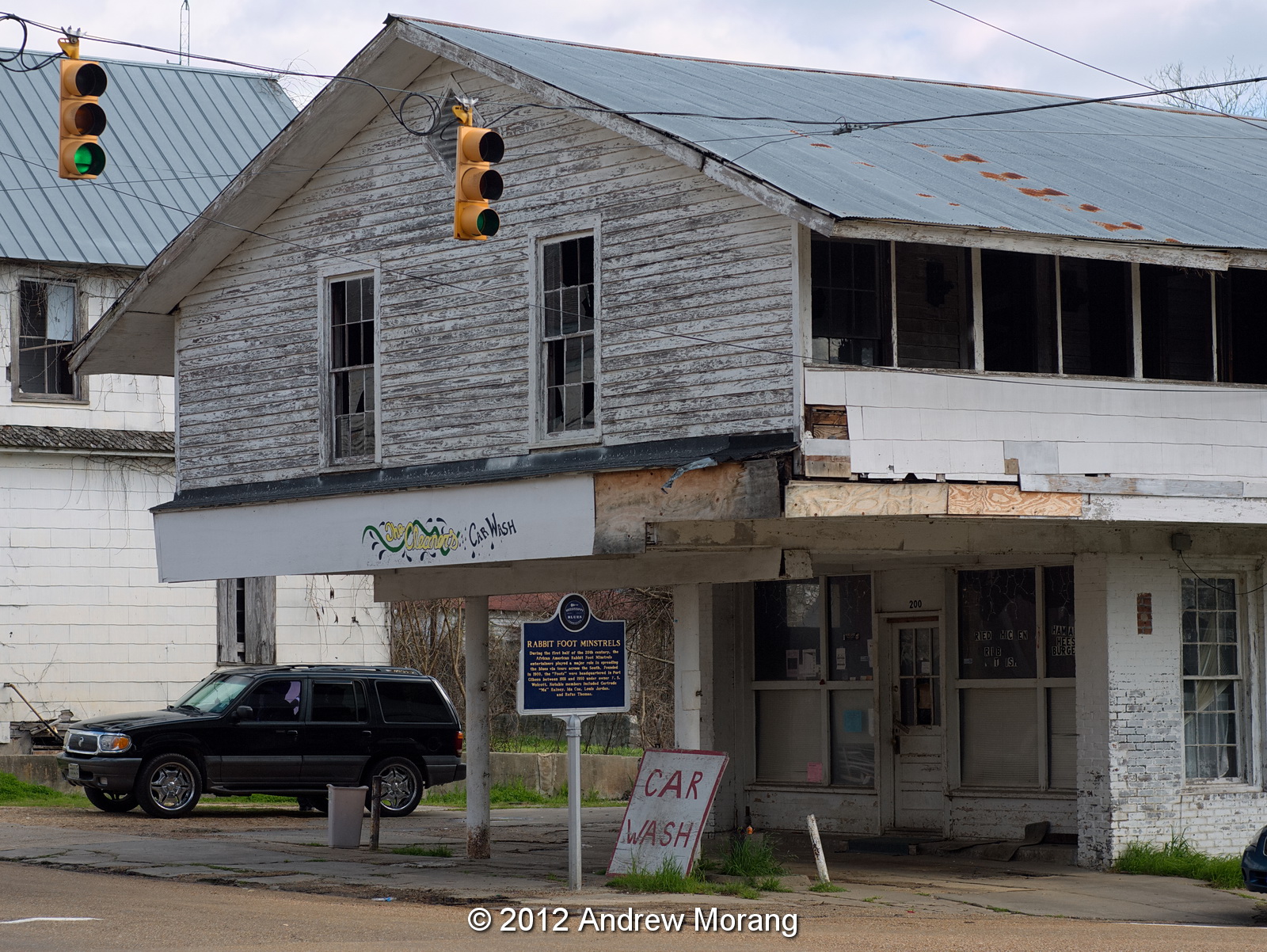
This was the former gasoline station at 200 Carroll Street, one of the buildings that burned. I took this photograph from a park across the street with a long lens. Some dudes drove up in a black SUV and waited for awhile. Then other dudes drove by, chatted for awhile, and exchanged packages. Sigh, another example of decay in America.
This is the old Trace Theatre on Main Street. I do not know if it is used.
This was a former grocery store on Carroll Street, also long deserted.
A short distance west of town is Vandeventer Street, with a number of houses that had seen better days a long time ago.
The reason I drove to Port Gibson that cold day in early 2012 was to see the remnants of the cotton seed oil mill on Anthony Street. The brick building in the center of the upper photograph dates to the 1800s.
A work crew was dismantling the machinery in this part of the mill. They said the machinery was being shipped to a factory in Nigeria.
East of Port Gibson on Hwy 18 is (or was) this pink club. The owner said she did not allow any trouble in her place. 

I need to return to Port Gibson before the rest of the town falls down or is dismantled. The 2012 photographs were taken with a Panasonic G1 camera with various lenses. The gas station and brick grocery were with a 50 mm Leica Summicron lens on the G1. Raw files processed in PhotoNinja software.

Thursday, December 17, 2015

More Urban Decay: West Porter Street, Jackson, Mississippi

Jackson west of the railroad tracks was once a prosperous, busy area of small shops, warehouses, and industrial concerns. Further west were tree-shaded neighborhoods, schools, and churches. Today, warehouses are boarded up, houses are abandoned or crumbling, and empty lots give little clue as to what was once there. A few weeks ago, I drove south on South Gallatin Street and saw a brick warehouse at the intersection with West Porter Street. It warranted a few photographs. I think the street address would be 2034.
This is the view west along West Porter at sunset in November.
The little cottage at 2032 West Porter was abandoned. The small fireplace was probably intended for a coal stove insert.
The resident at 2030 restores interesting old American cars, real Detroit iron.
On the north side of West Porter is another warehouse or shop. I could not tell if any part of the building is occupied.
This is the view north along Gallatin Street. It is somewhat desolate now.
These are the Kansas City Southern railroad tracks at the Gallatin Street underpass. These massive girders are early 20th century, the great era of railroad construction.

Photographs taken with a Fujifilm X-E1 digital camera, with some frames through a 35mm f/2.8 Olympus shift lens (to eliminate converging lines). I processed some of the RAW files with PhotoNinja software.

Wednesday, November 18, 2015

Old Hattiesburg High School - Neglect and Decay

Thomas Rosell wrote an article for Preservation Mississippi on November 18, 2015, titled Not Good News from Hattiesburg. He documented the continuing collapse of the historic Easton High School. Thomas's article jogged my memory, and I found some photographs that I took in 2011 of the Old Hattiesburg High School at 846 North Main Street. 
This must have once been a handsome and proud building. I had never seen it before and was struck that such an edifice could be abandoned so carelessly. I read in the Hattiesburg American that Hurricane Katrina caused severe damage in 2005, followed by arson in 2007.
I was alone and did not want to venture inside, but I took some photographs of the doorways. Notice the steel bracing behind the handsome limestone entry porch. Hmmm, do our contemporary mega-schools have limestone entry halls?
Like many schools in the early 20th century, there were separate Boys and Girls entrances. But there may be good news: a November 16 article in the Hattiesburg American describes a proposal to develop the building into "age-restricted" housing. 
On a more optimistic note, the Italian Renaissance Revival-style Union Station and New Orleans & Northeastern Passenger Depot, at 308 Newman Street, has been restored and serves as an intermodal transportation center. The city acquired the building and land in 2000 and completed a 5-year, $10 million renovation in 2007. The Grand Hall is now used for art exhibits and social events. It's nice to see gorgeous old buildings like this still in use and respected for their architectural uniqueness.

Photographs taken with a compact FujiFilm F31fd digital camera.

Thursday, July 23, 2015

Deserted Culkin Academy, Vicksburg, Mississippi

(Note: click any photograph to enlarge it.)
Generations of Warren County students who lived east of Vicksburg went to school at the Culkin Academy, later the Culkin Elementary School. When I first moved to the area in the mid-1980s, Culkin was still open, and I recall a PTA fund drive to buy air conditioners. The last year of operation was around 1999. A coworker's children attended elementary school there before the new Sherman Avenue Elementary School opened.
The old "Culkin Academy" sign is still engraved in the architectural concrete. On the front wall, each window was topped with the symbol of an academic discipline (in this case, mechanics). According to a friend at Mississippi Department of Archives and History, the building can be considered Art Moderne style, designed by a Modernist master, E.L. Malvaney of Jackson. It was completed in 1942. This was during World War II, but construction obviously started before the war began, likely funded by the Works Progress Administration. The county was lucky on the timing because most civilian construction was terminated or put on hold during the war years.
The classrooms are a mess. Many of the windows no longer have plywood covers, so I was able to place my camera on the window ledges and use time exposures. For a few years, a fellow rented the building and raised worms (yes, a worm farm). But I can't tell in what part of the building this animal husbandry occurred.
Not much is happening out back on a sultry summer day. 

Suzassippi wrote about how the high school in Eupora, Mississippi (now the Webster County school district), may be an architectural match to the Culkin Academy

There may be a use for the Culkin school yet. On July 7, 2015, the Vicksburg Post reported:
The sheriff’s department uses a building on the school’s campus for self-contained breathing apparatus training and tactical training like searching through smoke filled rooms, Warren County Sheriff Martin Pace said. The department also practices intruder simulations besides using the site for other law enforcement training purposes. Pace said it gives the department’s employees real world experience so they can be prepared for any emergency that might arise in the schools, offices or other locations.
Photographs taken with a Panasonic G3 digital camera with the Panasonic Lumix 12-32mm lens. I processed the raw files and converted to black and white with PhotoNinja software.