Showing posts with label Olympia. Show all posts

Sunday, June 12, 2022

Exploring the Capital (Olympia, Washington) (Oly 02)

Washington State (from netstate)
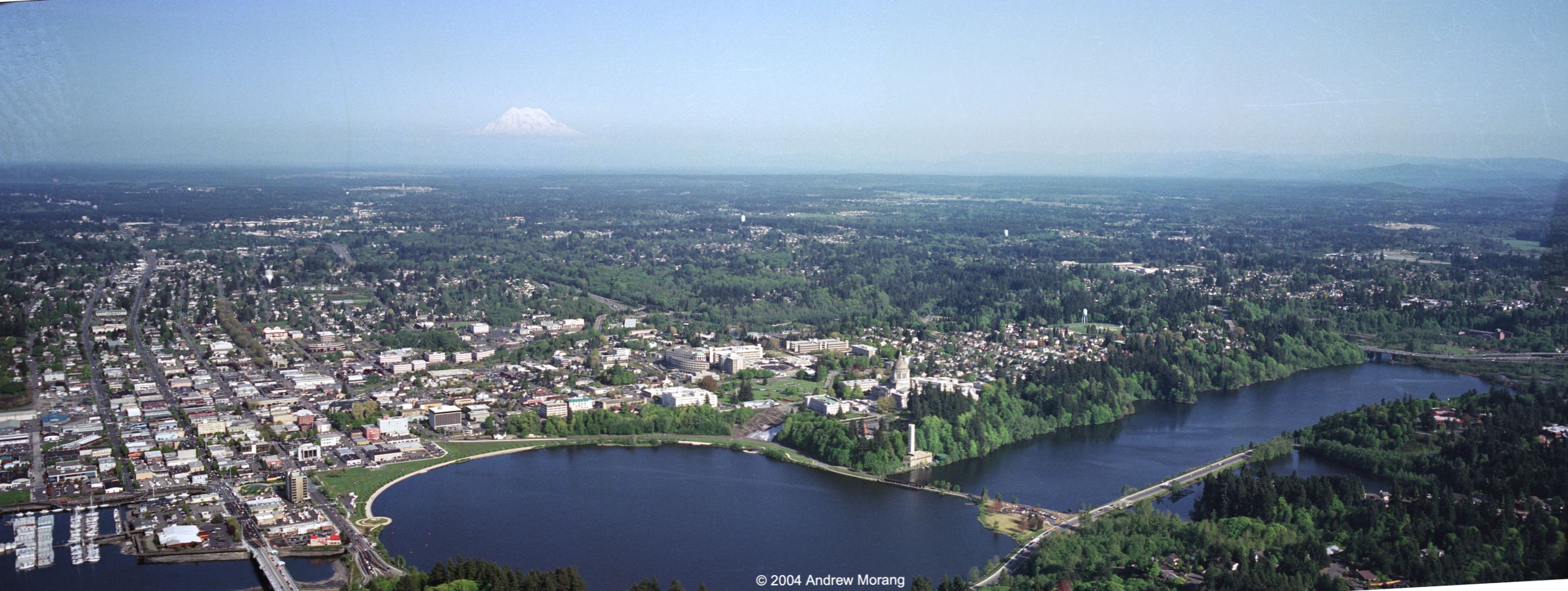
Olympia and Capitol Lake (Hasselblad XPan camera, 45mm lens, Fuji Reala film)

Olympia is the capitol of Washington State. The city is nicely situated at the south end of Puget Sound about one hour southwest of Seattle (or 2 or more hours during rush hours - which last much of the day). Olympia is a nice little city with a population of about 55,000, but that increases to around 270,000 if you include nearby Lacy and Tumwater. Olympia was only incorporated as a town in 1859, making it a new city compared to where I have lived in the past. 

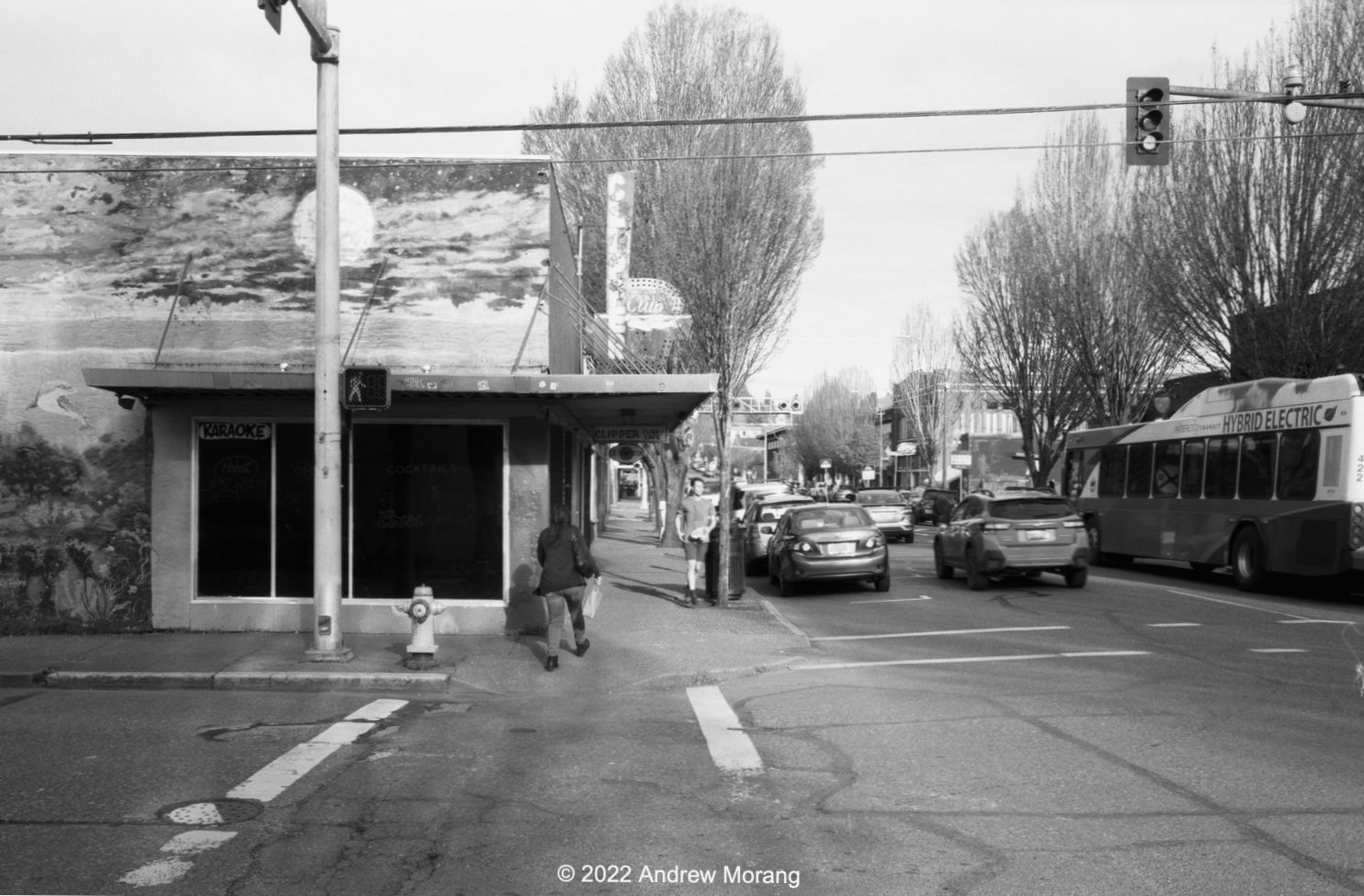
4th Avenue, view east

The downtown is reasonably well-preserved and active. But it did not strike me as especially dynamic despite being the state capital. It definitely has a less frenetic pace than Seattle or Tacoma. In the business district, most buildings appear to have tenants, and I saw bars, restaurants, banks, coffee shops, and theaters. Some of the downtown has the look of Old American City, a place that may have enjoyed a more golden era decades ago. 4th and 5th Avenues look grungy and a bit dingy.

Railroad bridge over Capitol Lake (35mm ƒ/2 Summicron lens) 

The rail network through the city is a bit complicated. This bridge crosses Capitol Lake (see the aerial panorama above).

7th Avenue Tunnel from Columbia St. SW (50mm Summicron, ƒ/4.0½)

After the rail line crosses Capitol Lake, it turns north and then turns east through the 7th Avenue Tunnel. I met a homeless man emerging from the dark and he said people regularly walk through it (hmmm, not me). A few years ago, a homeless fellow was struck by a train and lost an arm.

7th Avenue Tunnel from Jefferson Street (90mm ƒ/4 Elmar lens, 1/125 ƒ/4.0½)
7th Avenue (50mm Summicron lens)

 It took some looking around to find urban decay topics, but I found some.


When I asked a homeless fellow where the railroad tunnel emerged, he said near the black house. I did not know what he was talking about until I saw this old house coated with black paint. (Update: the house has burnt down.)

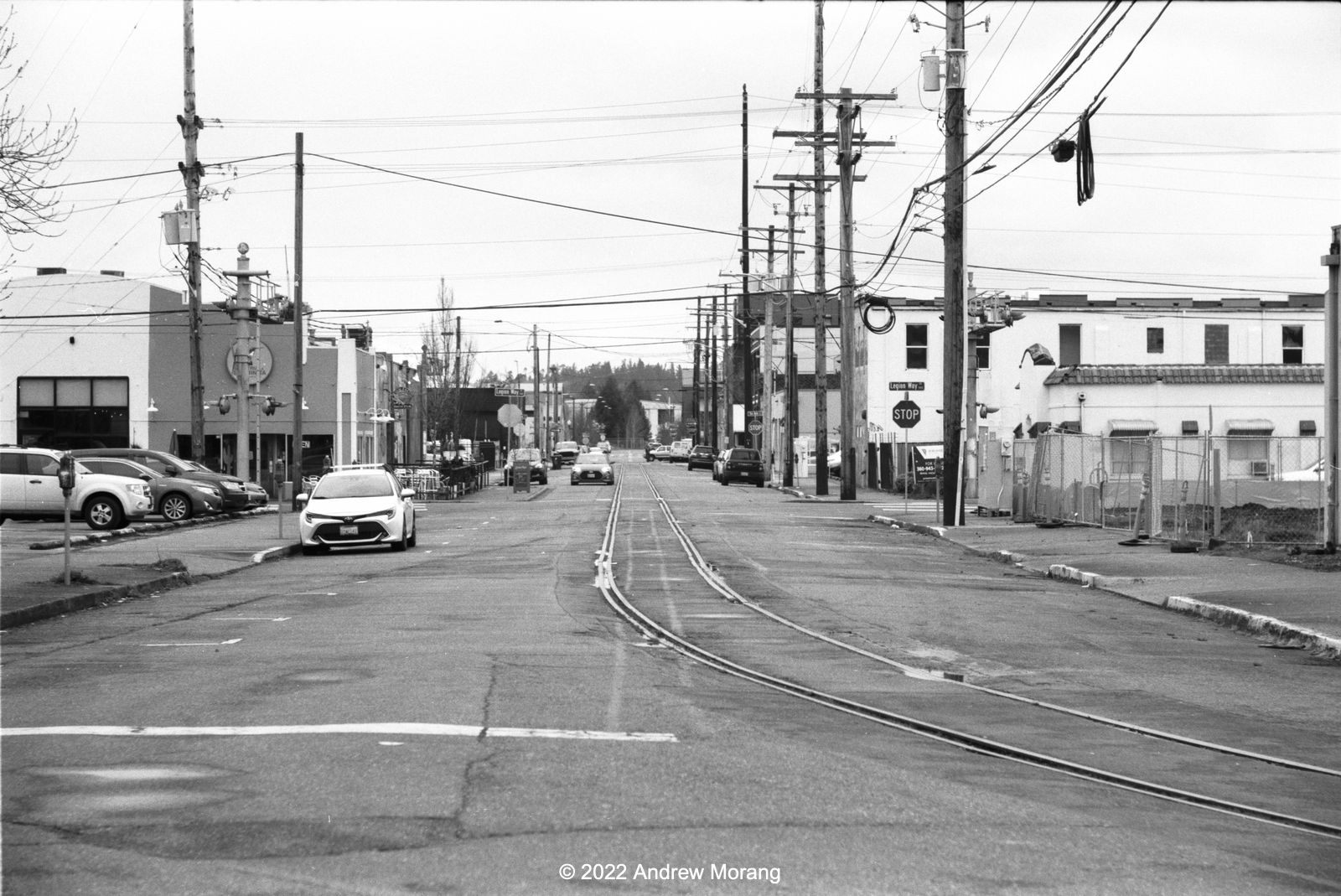
Jefferson Street view north (90mm ƒ/4 Elmar lens, 1/125 ƒ/5.6)

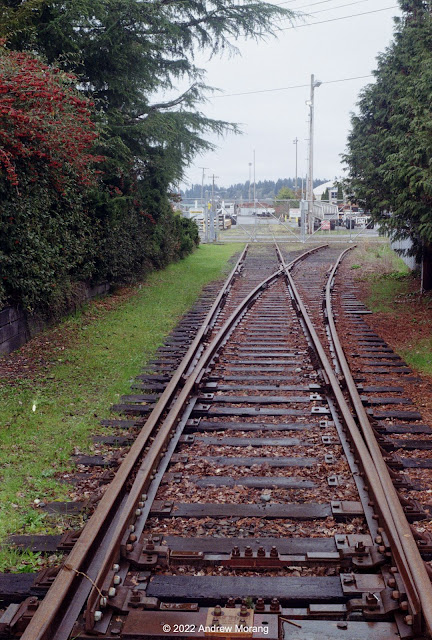
The tracks run down Jefferson Street to the Port of Olympia. I thought they were unused until one evening, I heard the familiar clanging and horn of a locomotive. 

Lumber pier, Woodard Bay Natural Resources Conservation Area (90mm Elmar, 1/250 ƒ/8.0)

The Woodard Bay Natural Resources Conservation Area is northeast of downtown. The pier once served Weyerhaeuser Timber Company's rail cars bringing lumber from the south. Formerly known as the South Bay Log Dump, cranes loaded timber onto barges, which then took the wood to mills in Everett. Today, the pier supports colonies of yuma myotis and little brown myotis bats. They forage as far as Capitol Lake and eat tons of insects every night. 

No coffee today, 3525 Shincke Road

This ends our short tour of Olympia. Type "Olympia" in the search box to see older articles.

The black and white photographs are from Fuji Acros film exposed at EI=80 in my Leica M2 camera. Northeast Photographic in Bath, Maine developed the film, and I scanned it with a Plustek 7600i film scanner. The aerial panorama is from 2004, when I spent a few months in Seattle on a work project at Willapa Bay. A friend flew me over Olympia and to the coast.

Sunday, May 22, 2022

1950s Optical Excellence: Kodak Retina IIa Camera

Kodak Retina IIa, made in West Germany from 1951-1954

Background


The Kodak Retina was a highly-respected camera in the 1950s and 1960s. I never used one, but several friends said the lenses and output were excellent. So, in one of my occasional GAS (Gear Acquisition Syndrome) episodes, I started looking on the infamous eBay (now known as ePrey). Amazingly, some bargains in film equipment are still to be found there, but you need to be patient and look at the descriptions carefully. In early March (2022) this handsome little Retina model IIa (Type 016) came from a US vendor for all of $37, including shipping. It also included a medium yellow filter and a case. $37? How is this possible?

Retina Cameras


The most famous Retinas were folding cameras. This means the lens would pivot or fold into the body to make the unit more portable. You click a button to release the front door, and it swings open and shifts the lens into position. Before WWII and through the 1950s, folders were popular because they were compact. Medium format models tended to have problems with lens alignment, but 35mm models were smaller and more rigid. Zeiss Ikon, Agfa, Voigtländer, Certo, and other companies made various models. The finest may have been Voigtländer's Vito III with its superb 50mm Ultron lens, one of the best 50s of the mid-20th century. But Kodak sold the largest number of folders.

By the mid-1950s, solid body cameras became the dominant design because the lens could be mounted more precisely and remain aligned over time. 

Kodak made these superb little Retina cameras at their Nagel-werke subsidiary in Stuttgart, Germany. For reasons that I never understood, the mighty Eastman Kodak Company was unable to successfully make higher-end 35mm cameras in the USA. They made millions of snapshooter-level cameras for casual photographers, and their large-format lenses were well-respected, but precision 35mm cameras for enthusiasts eluded them. 

Dr. August Nagel himself designed the original Retina in 1934. It held Kodak's 35mm metal film cassette, the same format that we still use today. Various Retinas of increasing sophistication followed for the next 35 years. 

The models are confusing, and a Wikipedia article and retinarescue.com list the varieties of the post-war models in more detail than I can:

  1. I series. 1945-1960. Viewfinder folding cameras with ƒ/3.5 to ƒ/2 lenses.
  2. II series. 1946-1958. Nagel-werke added a rangefinder to improve focussing. My IIa is in this group and has a superb 50mm ƒ/2 Schneider Xenon lens.
  3. III series. 1954-1960. The most sophisticated models with both a selenium light meter and rangefinder. Most of the selenium meters have failed by now.
    • The IIIc models allowed the front optical group to be exchanged with 35mm and 80mm groups. It was clumsy but worked. 
    • The IIIC (large C) models had an improved viewfinder and also accepted the interchangeable front lens elements. 
  4. S series. Rigid bodies, 1958-1966. The IIIS used interchangeable lenses with the DKL (or Deckel) mount. They needed the S series lenses with a focus cam for the rangefinder. Beautiful cameras but very complicated internally
  5. Retina Reflex. 1957-1967. Totally different leaf shutter bodies. The Type 025 could use the same lens elements as the IIIc series above, while the later Reflex S used the DKL lenses. These did not successfully compete with Japanese reflex cameras in the 1960s. When working, they were excellent optically.
  6. Retinette series. These were lower cost with Reomar triplet lenses. Some of there bodies were almost identical to Retina bodies. 


Retina IIa with front panel closed. The lens and shutter are protected.
Coated Schneider-Kreuznach 50mm ƒ/2 Xenon lens (6 elements), approx. 1952-1953. Filter size: 29.5mm
Shutter with range 1 sec to 1/500 sec. The distance scale is in feet for the US market.
Film guide and spools - all precision machining

My IIa has a 6-element Schneider Xenon lens, a unit focus 6-element design. Unit focus means the entire lens moves forward and back as you focus. This lens is coated, as indicated by the blue tinge and the red arrow on the label. I assume this was a post-war computation, but the early-1950s would have been before the designers used computers for lens design. Rodenstock also supplied lenses for Retinas, usually the models sold in Europe. Notice the precision labels, metalwork, and mounting of the shutter and focus scale.

The filter size is 29.5 mm screw-in or 32mm push-on. Genuine German Kodak filters are thin enough to remain mounted when the lid is closed. Why do the most modern 50mm Über-lenses for mirrorless cameras need 67 mm or even larger filters? 

More Information


You can find many reviews of Retinas on the web. They are popular with their current owners. I am surprised I do not see them in use. Of course, one rarely sees film cameras at all in use, but someone is buying them as well as film. 

Cameraquest states that the IIa is his favorite model.

Photography & Vintage Cameras also prefers the IIa to other Retina models. 

My friend, Jim Grey, loved his IIa but then let it go, which he now regrets (he will probably buy another one...). He also demonstrated the excellent optics of a IIc model. 

Mike Eckman dot com wrote a detailed review of the IIa and a summary of the Kodak company's association with its German subsidiary. He has reviewed other Retina models, as well.

Chris Sherlock in New Zealand is the reigning expert.

Photo Thinking also loves the IIa.

Random Camera wrote a good review of all German folders, with emphasis on the Retinas. He liked the IIa, too.

Photojottings described the superb and sophisticated Retina IIIC, the one with auxiliary lenses.

All My Cameras liked the II (Type 014), the predecessor to my IIa. 

Is this Retina camera any good?


Well, that is the big question, of course. How is it optically? Here are some Kodak Gold 200 photographs from a recent trip to the Pacific Northwest. Click a frame to see 1600 pixels on the long dimension. You can judge for yourself, and I welcome comments, criticisms, insults, anything.

Olympia, Washington

Port of Olympia (next to the Dancing Goats® Coffee Tasting Room!) 
Swantown Marina, Port of Olympia
Thurston County Food Bank, 220 Thurston Ave., NE, Olympia

The Food Bank serves hundreds in need in the Olympia area with food and other essentials. 

Frog Pond Grocery in the historic South Capitol area (1/250 ƒ/5.6)

Olympia is a nice little city at the south end of Puget Sound. You will see more Olympia photographs in the future. 

Southwest Washington


Driving through rural Washington, interesting photo topics popped up and said, "Photograph me."

I am in the Danger Zone, Rte. 101, Skokomish (1/250 f/8)
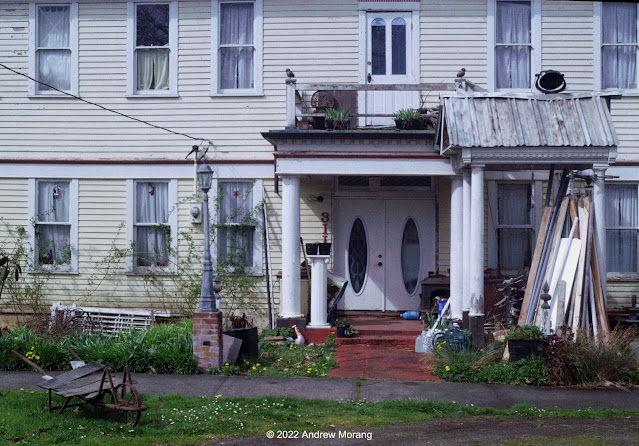
Fixer-upper hotel, 311 Main Street, Pe Ell, Washington (1/250 ƒ/11)
Room with a view, Park Avenue, Aberdeen (the building really is curved; 1/100 ƒ/5.6½)

Aberdeen has a wealth of delicious grunginess. It is on my return list.

Astoria, Oregon


Great blue heron, Columbia River, Astoria, Oregon
Former US Mail railroad car, Astoria, Oregon

Summary


This little Kodak Retina is a jewel of 1950s Germany precision manufacturing and optical excellence. I certainly can't complain about the lens resolution or body rigidity. Imagine the skill of the technicians who assembled these cameras on workbenches. 

On mine, the rangefinder was cloudy and a bit out of alignment. I sent it to Paul Barden in Corvallis, Oregon, for a thorough cleaning and adjustment. After seven decades, I need a cleaning and adjustment, too! Mr. Barden said the camera was in good condition, and minor fungus in the rear group cleaned off without etching the coating. The rangefinder is rather squinty and is not as brilliant or defined as one in a Leica M, but what do you expect?

The leather case was seriously stinky, but I washed it and re-glued the lining to the outer shell. It works well, although normally I am not a user of camera cases. I also fixed four "Zeiss bumps", bumps where rivets under the leather build up a blob of tarnish.

These Retinas are still somewhat inexpensive on the 'Bay. When will they become the next trendy in-thing for film photographers? Buy before the prices go up, and enjoy.

Update July 2022: The cleaned and overhauled the IIa is home. Now I need to make time to use it. Here are photographs of Houston, Texas, in November of 2022.


Sunday, April 10, 2022

The Wide View in Western Washington (Hasselblad XPan 01)

Panoramic Cameras


For years I experimented with panoramas. In the past, I took a series of photographs (usually horizontal) with a normal camera and included about 25 percent overlap on each frame. Then I mounted prints on a long board and made a physical panorama. This worked best with 50mm or longer lenses because they did not suffer from distortion or light fall-off at the edges. 

More recently, I have scanned the negatives and merged them electronically using Adobe Photoshop. The software is amazingly effective, and often you barely see the junctions where the negatives overlap at all. The quality of the merge depends on whether the lens displays darkening or unsharp areas at the edge of each frame. Regular readers may remember panoramas from Lower Manhattan and Logan Airport in Boston (click the links).

For a century, camera makers invented various types of cameras that  exposed a wide piece of film. That way, you did not need to combine separate pieces of film or glue prints on a board.

There are three main types of panoramic cameras:

  1. Stationary lens wide body. The camera body holds a wide piece of film and mounts a lens with sufficient coverage to expose the entire frame. Some examples include Former and Schwing's 7×17 and even 12×20 inch banquet cameras. Can you imagine the size of the latter monster? Mid-century, it was more common to use 6×12 and 6×17 bodies that held 120 film. Some of the best are the gorgeous Linhof models. The disadvantage of these wide bodies is that objects at the sides of the frames become elongated. Think of a round ball that becomes stretched along the axis of the film. That is why most photographers do not use wide angle lenses for group portraits - people at the edge look wide. 
  2. Rotating or swing lens cameras. These are ingenious machines. The lens is on a motorized pivot. The film back is curved, and as the lens moves, it paints the image on the film. With this design, objects at the edge do not become elongated. 
  3. 360º rotation camera. The entire camera rotates through a circle while the film moves at the same speed past the lens. One example is the famous Swiss Roundshot. These provide amazing panoramas from mountain tops or cityscapes from towers. 

An excellent introduction to this type of photography is: Meechem, Joseph, 1990. Panoramic Photography, Amphoto, New York, 144p. 


Hasselblad XPan camera with 45mm ƒ/4 lens and center filter

Lens Options


Two other methods let you create panoramas with an ordinary camera.
  1. An anamorphic lens compresses the image in one direction while leaving the other unchanged. These were developed for cinematography when wide-screen movies became popular (think of Cinemascope). The film remained the normal size. At the cinema, an opposite (or anti-) anamorphic projection lens recreated the wide view that had been filmed on the set or in nature. These lenses were originally spectacularly expensive, but some Chinese companies are selling new version. 
  2. A shift lens can be mounted on any 35mm camera. Take one picture with the lens shifted full to the left, then a second frame full to the right, and merge the frames with Photoshop. I still have an Olympus OM 35mm ƒ/2.8 shift lens. I need to buy an inexpensive body and put the lens back into use.

The Hasselblad XPan


Between 1998 and 2006, Fujifilm made a spectacular camera, the TX-1 (and updated it with the TX-2). Hasselblad marketed them in the USA and Canada as the XPan and XPan-2. This camera looks like a modern rangefinder body, but it is wider. The film opening is 24×65 mm, in contrast to the normal 35mm camera, which exposes only 24×36 mm. Fuji made three superb lenses, 30mm, 45mm, and 90mm. The 30mm and 45mm lenses had optional center filters to even the exposure across the frame. With the recent revival in film photography, TX-1s and XPans are highly coveted and seriously expensive (a 3-lens kit complete with the center filters is a third or half the price of a new car).

Willapa Bay and Grays Harbor, Washington


The coast of Washington has two large estuaries or rias facing the Pacific Ocean. The southern one is Willapa Bay. Grays Harbor (no apostrophe in the name) is a few miles to the north. 

In 2004, I spent a few months working in Seattle on an erosion study of Willapa Bay. A friend offered to fly me to the coast, and I rented an XPan from Glazer's Camera. He had a perfect airplane for the trip because the window opened (or maybe it had no window, I can't remember).

Mouth of Willapa Bay, view west to the Pacific Ocean

Willapa Bay faces the Pacific Ocean. Most of the bay is protected from the open ocean by the Long Beach Peninsula, a long sand spit composed of sediment brought down to the ocean by the Colombia River. The mouth of Willapa Bay has been very dynamic and has migrated north more than a kilometer in a century. This northward migration threatened the formerly-protected shellfish grounds used by the Shoalwater Bay Tribe and threatened their homes. 

In 1866, President Andrew Johnson created the 334-acre Shoalwater Reserve for the Willapa Bay Chinook people under the Treaty of Olympia. During the 1990s and 2000s, the village occupied by the tribe (lower right in the photograph above) suffered wave action and threat of severe erosion. The US Army Corps of Engineers conducted a study of hydrodynamics, sediment movement, and geology to evaluate if they could protect the village. If you are interested, Appendix 1, Engineering Analysis and Design of the 2009 study titled, "Shoalwater Bay Shoreline Erosion, Washington, FLOOD AND COASTAL STORM DAMAGE REDUCTION, Shoalwater Bay Indian Reservation" describes the data and analyses used in the study (full disclosure, I was the author).

Heading north, Grays Harbor is another large estuary with a dangerous Pacific Ocean mouth. This bay was historically important for the fur trade, fishing, and the timber industry. 


Timber yard, Aberdeen

Grays Harbor's largest city is Aberdeen, located at the east end of the bay at the mouth of the Chehalis River. During the early 20th century, Aberdeen was the world's largest timber port. Much of the timber today is shipped to Asia.

Olympia


Washington State capitol, Olympia


Olympia, in Thurston County, is the capital of Washington State. The marble dome of Capitol building is said to be the fifth highest masonry dome in the world. This a nice mid-size city, without the congestion and frenetic pace of Seattle, which is about two hours to the northeast. Olympia has a famous Farmers' Market, where you can indulge your wishes for a gastronomic overload of locally-sourced healthy vegetables and fruits. 

Tacoma


Tacoma is an industrial city at the south end of Puget Sound, about an hour south of Seattle. In the 1970s, Tacoma had major steel and paper mills. When the wind blew from the south, we smelled it in Seattle and called it "Aroma of Tacoma." Today, Tacoma has gentrified but remains a major port handling timber, bulk cargoes, petroleum products, and automobiles.   


Tacoma harbor, view west
Fisherman cottage, Tacoma (look out for the tsunami)

What a nice place for a cottage: view of the sea, clang on the buoys, swish of the waves, salty/briny smell of the intertidal flats. But when the Cascadia subduction zone finally has a big slip, the tsunami will rush into Puget Sound and wash away this little cottage. 

Browns Point, NE Tacoma

Browns Point has some nice residences on the bluff top and along the base. I do not know about geotechnical issues for the residents at the top with a view. Still, it would be nice.

Port of Tacoma

Want a car? Take you pick, all the finest from Japan and Germany.

Stand by for panoramas from Seattle in a future article. Please click any photograph to expand it. 


Saturday, October 30, 2021

Food Overload: Farmer's Market, Olympia, Washington


Oh oh, no urban decay this time, just a quick view of real food at the Farmer's Market in Olympia, Washington. Long-term readers know I can't resist exploring markets. The one in Olympia is full of locally-sourced and fresh fruits and vegetables. Enjoy and salivate.


The fruits and berries are just superb, but you know this already.


The legumes and root vegetables are just as good and tasty as the fruits. I wonder if these excellent produce items partly account for the better health of Northwest residents (and lesser volume) compared to those of the US South? Or is it the other way around? Northwesterners demand better produce, and farmers supply it. 


Want a variety of peppers of different heat indices? Go for it.


Fruit preserves, hand-crafted soaps? Plenty to select.

You are expected to behave in a civilized manner here. It is a pity that at least a third of the population in USA now needs rules of common etiquette like this. 


After your shopping basket is groaning under the weight of fruits and veggies, stop at Batdorf & Bronson for a supreme espresso. Highway 61 Coffeehouse in Vicksburg sources its coffee from this company.

I have photographed other farmer's markets before. They are so much fun. Click a link to see:

The Olympia scenes are digital files from a Fuji X-E1 digital camera.

Friday, July 17, 2015

On the Delta: the Nisqually National Wildlife Refuge, Washington

When you visit Olympia, Washington, a great day's outing is to walk in the Nisqually National Wildlife Refuge. 
"Nisqually National Wildlife Refuge is located where the freshwater of the Nisqually River meets the saltwater of south Puget Sound, creating the Nisqually River Delta. The delta is a biologically-rich and diverse area that supports a variety of habitats including the estuary, freshwater wetlands and riparian woodlands. It is considered the last unspoiled major estuary in Puget Sound. The Nisqually Delta has been designated as a National Natural Landmark because of its national significance as one of the best examples of this kind of coastal salt marsh system remaining in the North Pacific.
Nisqually Refuge is famous for the more than 275 migratory bird species that use the refuge for migration, wintering, or breeding. The refuge provides rearing and migration habitat for steelhead trout and several salmon species, and habitat for a variety of threatened and endangered species. The Black River Unit, southwest of Olympia, provides high quality habitat for Coho and Chinook salmon, steelhead trout, migratory birds, and a diversity of other species." (from the US Fish and Wildlife Service).
The first European settlers came to the area in the 1830s. By the late 1830s, the economy began to shift from fur trading to farming and sheep-grazing. During the late-19th century, settlers throughout the Puget Sound area built dikes and drained river deltas. The soil in the former tidal marshland was rich and fertile, making excellent flat farmland. But as a consequence, estuarine habitats were lost, including much of the Nisqually River estuary.
The Fish and Wildlife Service is slowly removing some of the old dikes and allowing natural tidal flow to return to the creeks and channels. The photograph above, taken at low tide, shows pilings in one of the channels, possibly remains of weirs.
In 1904, a farmer, Alson Brown, and his wife bought 2,350 acres in the Nisqually delta. He built dikes and converted the fertile land to crop production and to chicken, hog, and cattle farming. After World War I, Brown went bankrupt, but subsequent owners raised the dikes and built the tall twin barns in 1932. This was during the Depression - how did they raise the funds?
The barns were damaged in the 2001 Nisqually Earthquake and have been closed since then. They are secured and in reasonably good condition, so the Fish and Wildlife Service has maintained them to some extent. On a sunny clear day, they are a nice photographic topic.
Let's briefly look at Olympia. 
 This is downtown Olympia from the west.
The state capitol was begun in 1890 but construction languished because of funding issues. The building was finally completed in 1928, during the easy-money years of the Roaring Twenties. At a height of 287 feet, the dome is said to be the fifth tallest masonry dome on earth, meaning a dome held up by its stone bearing walls without reinforcement.The US capitol in Washington is higher, at 302 ft, but it has a steel framework. The 2001 earthquake caused serious damage and required a $118 million renovation and internal reinforcement.

Trivia item: The Capitol has the largest collection of Tiffany lights in the world, some 438 units. Go see them. The chandelier above the rotunda weighs 10,000 lb and is suspended 50 feet above the floor. Serious lamp.
Washington State is a wonderful place to live if you like organic vegetables and fruits and locally-sourced ingredients (like Italy, Spain, or other civilized places with a real food culture). Apples and pears are local specialties. This photograph is from the farmers' market in downtown Olympia.

Camera notes: the square frames are from a Fujifilm X-E1 digital camera, with raw files processed in PhotoNinja software. A polarizing filter helped darken the sky on this amazingly clear and sunny February day. The long wide panoramic frames are from a Hasselblad XPan film camera (which was manufactured by Fuji). The XPan had a film opening of 72x24mm, or twice the width of a standard 35mm camera frame. A friend took me flying over the area in a cloth airplane of the type where you can swing open the window.