Showing posts with label Summitar. Show all posts

Sunday, March 27, 2022

The Football Scenic Road, central North Carolina (Abandoned films 08c)

North  Carolina Scenic Byways (from NC Department of Transportation)

Introduction


The State of North Carolina has a network of scenic byways that cover many of the historic and scenic parts of the state. If you go to the Department of Transport web page, you can download a book of the byways and look at an interactive map. You can also request a printed copy of the book.

The screen capture above is the online map on the NC-DOT web page. The blue line in the west is the Blue Ridge Parkway. Long-term readers may remember that I have driven much of the Parkway in 2017 and 2018. I have also driven the Nantahala and Fontana (Rte. 28) Byways. It is beautiful terrain in the west. 

For the urban decay photographer, the state is a treasure trove of old farmhouses, mills, factories, and quiet little towns that look like time passed by. 

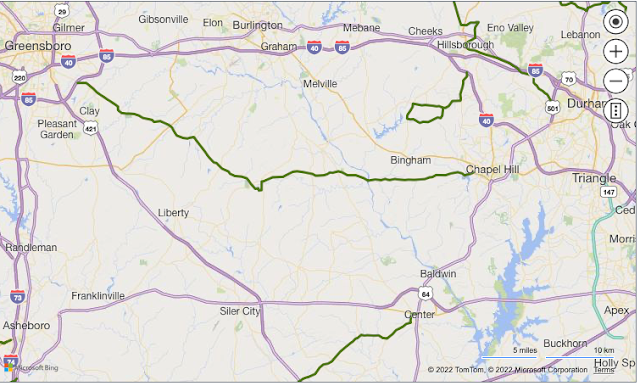
The Football Road (west of Chapel Hill)


The DOT calls the route between Chapel Hill and the outskirts of Greensboro the Football Road. I do not know why it has this name. But it goes through nice farm country and avoids the boring Interstate 40. Part of it is Old Greensboro Road and then becomes the Old Greensboro-Chapel Hill Road.

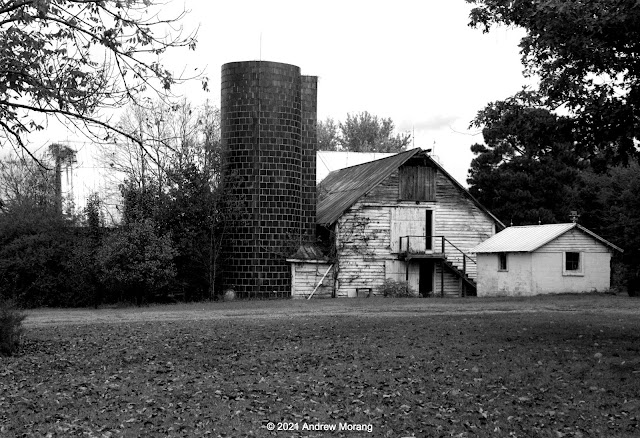
Barn on Old Greensboro Road, near Chapel Hill
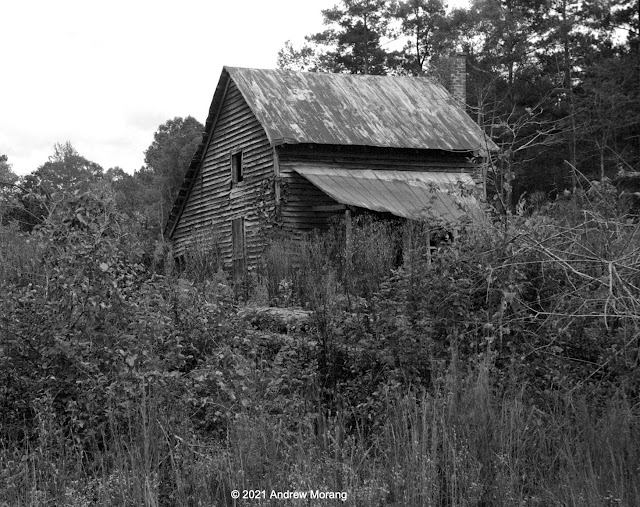
Farm house, Dawson Road near Chapel Hill
Farm, Old Greensboro Road near Chapel Hill
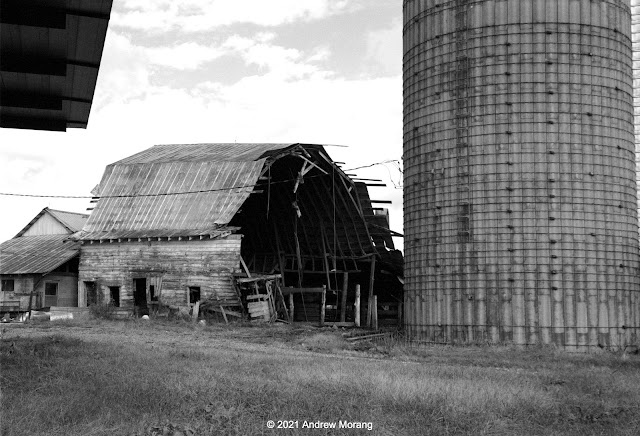
Barn, Greensboro-Chapel Hill Road near Snow Camp
Farm, Greensboro-Chapel Hill Road near Snow Camp (Jupiter-8 lens, yellow filter)
Happy cows, Greensboro-Chapel Hill Road near Eli Whitney

The Greensboro-Chapel Hill Road winds its way past farms and woods. An occasional car or tractor passes by. I was surprised that many of the silos consist of concrete tubes reinforced with exterior steel bands. It is a cylindrical version of a barrel. 

Fixer-upper house, Greensboro-Chapel Hill Road, near Snow Camp

Snow Camp


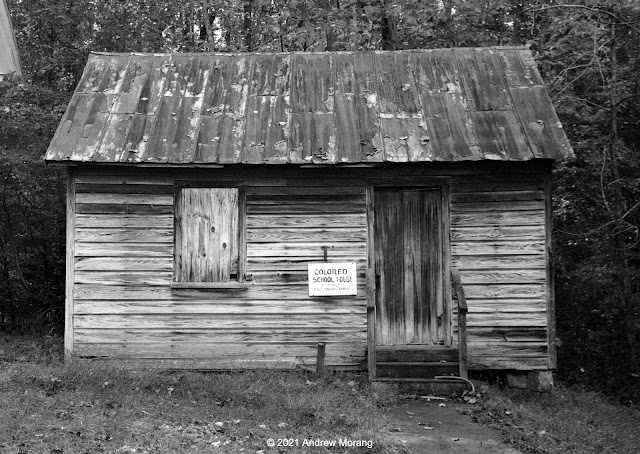
Historic school, Snow Camp Outdoor Theatre, Snow Camp
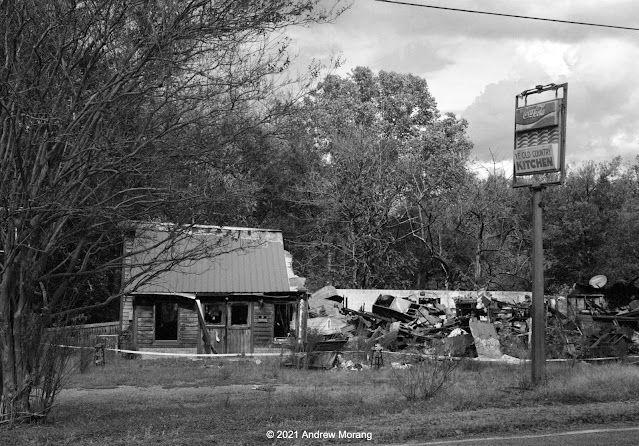
Restaurant next to Snow Camp Outdoor Theatre

The Snow Camp Outdoor Theatre is at 301 Drama Rd. (great name!) in Snow Camp. The site was empty when I visited in October, but in-season, the semi-professional company has been presenting plays for over 40 years. The restaurant next door will not be providing any meals for a long time..... 

Unoccupied farm, Holman Mill Road, Snow Camp

This ends our short excursion on the Football Road in central North Carolina. The time was late and I had to return to Chapel Hill.

These photographs are all on Kodak BW400CN film from my little Leica IIIC camera. I used my 5cm ƒ/2 Summitar and 50mm ƒ/2 Jupiter-8 lenses, often with a yellow filter to enhance clouds.

Tuesday, March 15, 2022

Huge architecture: Mills of New Bedford, Massachusetts (Abandoned films 08b)

Introduction

New Bedford is a historic seaport, whaling town, and industrial city facing Buzzards Bay on the south coast of Massachusetts. 

According to Wikipedia, New Bedford was once known as "The Whaling City" because it was one of the world's most important whaling ports in the late-eighteenth and nineteenth centuries. Whaling declined after the 1860s when petroleum was discovered in Pennsylvania and as overfishing almost eradicated whale populations around the world's oceans. 

Textile manufacturing replaced the whale trade (from Wikipedia):

In the midst of this decline, greater New Bedford's economy became more dependent on the textile industry, which began to eclipse the whaling industry in the late 19th century. The mills grew and expanded constantly, eventually comprising multiple sites along the Acushnet River. In 1875 alone, the Wamsutta Mills processed 19,000 bales of cotton into 20 million yards of cloth, which had a wholesale value comparable to that of the entire whaling catch, and continued to produce over 20 million yards of cloth yearly after 1883. The Wamsutta Mills remained the world's largest weaving plant until 1892.
My wife and I briefly visited New Bedford in late 2021 and looked at some of the monumental mill buildings. Many are empty now, but some have new uses, including residential. The New Bedford Economic Development Council prepared a City of New Bedford Historic Mill Inventory in 2008. You need to walk around some of the structures to see what huge businesses these must have once housed and image how many thousands of workers once toiled inside. We have seen similar huge brick mill buildings in Lewiston, Maine, in 2003 and Łódź, Poland, in 2016 (in a pre-Covid life).

New Bedford Harbor


Harbor Street, New Bedford. Note mill worker houses in the distance
Former power plant, Harbor Street (5cm ƒ/2 Summitar lens, orange filter)
Mill view from Gifford Street (taken from US Army Corps of Engineers hurricane surge barrier)

Clarks Cove


Clark's Cove is on the west side of the city, with Rodney French Boulevard running along the shore. We stopped at a driveway leading into a mill complex at 89 Rodney French. The gate was open and no one was around. I could not find a name of the complex or the name of the former milling company. The 2008 inventory does not list the original companies that operated these mills.


The Globe Furniture Company occupies part of the ground floor facing Rodney French. But most of the hulking complex appeared to be empty. The doors were secured and I could not go inside, but did not have enough time to look everywhere. 


The patterns of light and shadow were especially interesting in the harsh sunlight. I hope I can return with a 4×5" camera some day.


Details, patters, shapes, textures - no end to interesting photographic topics.

Workers' homes, Thatcher Street (digital image)

Another topic for a future visit is the worker housing that the cotton companies erected near the factories. The morning steam whistle would blow, and the factory workers walked to work.

I took the 2021 photographs on Kodak BW400CN film with my Leica IIIC rangefinder camera and the 5cm ƒ/2 Summitar lens. 

Tuesday, February 15, 2022

More Decay: Raymond Road and W. Highland Drive, Jackson, Mississippi

Parts of West Jackson, Mississippi, are just an utter mess. After walking around the deserted and trashed Nova Park apartments at 1115 Raymond Road in southwest Jackson, I drove a few blocks east. There were more empty apartments and abandoned houses.


This was another empty apartment just east of the Nova Park that I described in the previous post. It was a different architecture but still a generic commercial unit. However, it looked reasonably modern and intact; why was it empty? Some of the air conditioner units had already been looted.


Further east, I saw some tired and closed stores. 


And then there were the tired and abandoned homes. This brick Craftsman cottage with the tile roof was a handsome little home in the day, with well-done brickwork. Look at the interesting arches. What happened? Where did the residents go? 


From Interstate 20, you can see another group of empty apartments near the turnoff to US 49. These are (or were) the Highland Square Apartments on West Highland Drive. I drove by, and most are forlorn and empty, but not trashed. As of 2021, it looked like a few units were still rented, but most were closed. Once again, what happened? The news media keeps writing about a lack of housing, but yet here are empty apartments.

This ends our short tour of Raymond Road and West Highland Drive. Stand by for more Jackson exploration in the future.

I took these photographs on Fuji Acros film using my 1949 Leica IIIC and its original 5cm ƒ/2 Summitar lens. I added medium or deep yellow filters for scenes with sky.

Tuesday, February 8, 2022

Trashed apartment, Raymond Road, Jackson, Mississippi

Raymond Road is south of Interstate 20 in Jackson and connects Terry Road with MS 18 a few miles to the west. I rarely drive on Raymond Road, but in early 2021, I came across the abandoned Nova Park apartment complex at 1115 and could not resist stopping. It yelled "Dump" and "Come photograph me."

From a distance, the buildings look reasonably modern and intact, just architecturally boring. The roofs are fine. What happened?


Pass through the gate on one side and the trouble starts immediately. Like other apartments that I have photographed before, it looks like the tenants left in a hurry. Their possessions, televisions, toys, and junk are strewn about. The sheetrock has been trashed as vandals stole metal.

The worst thing about any abandoned property in Jackson is that it becomes a dumping ground for old tires, personal trash, and construction debris. Is there no municipal mechanism for disposing of materials? The perpetrators have no civic pride or regard for how they hurt nearby residents? Tires mean pockets of standing water, which means mosquitoes in summer. Trash demonstrates how a neighborhood is degrading.

I drove by about a year later, and, from the street, the site looked about the same. The hollowing out of America....

These photographs are from Fuji Acros film taken with my little 1949 Leica IIIC camera and its 5cm ƒ/2 Summitar lens. For most frames, I used a medium yellow filter and measured light with a Gossen Luna Pro Digital meter. I scanned the frames with a Plustek 7600i film scanner.  Click any frame to expand it and see more details.

Thank you for reading and standby for more Jackson adventures. For older articles, type "Jackson" in the search bar.

Sunday, October 24, 2021

Last Time Ever: 135-size Kodak Panatomic-X (Abandoned Films 05b)


Dear readers, this is it, the last time for 135 size Kodak Panatomic-X film. I exposed my last roll in and around Vicksburg and will likely never use any again (although I still am using 120 format rolls for medium format cameras). The Panatomic-X from eBay sellers is usually older than the rolls I used, and they almost never have information on how it was stored. Here are some examples from this last roll of the famous Panatomic-X. I exposed it at exposure index (EI) = 20 and sent it to Northeast Photographic in Bath, Maine, to develop.
 

Vicksburg, Mississippi


Cherry Street bridge, Feb. 16, 2021 (50mm Jupiter-8 lens, yellow filter, 1/30 ƒ/8)

This was one of our two unusual snowfalls in February of 2021.

Kroger supermarket, Pemberton Blvd. (Leitz 5cm ƒ/2 Summitar lens, deep yellow filter, 1/100 ƒ/4)

This is the site of the short-lived K-Mart store, which was poorly run and seldom had customers. This is a new building because the Kroger company tore down the K-Mart structure.

Pemberton Blvd., Vicksburg (Leitz 5cm ƒ/2 Summitar lens, deep yellow filter)
Parking lot north of Bunge terminal, Levee Street, Vicksburg (Summitar lens, ½ sec ƒ/11.5)

Kansas City Southern rail yard, Levee Street (Leitz Summitar lens)
"America" moored at the Vicksburg Waterfront, view down Grove Street (Leitz Summitar lens)
Kansas City Southern rail yard, Levee Street (Jupiter-8 lens, yellow filter, 1/20 ƒ/11)

Port of Vicksburg


Vicksburg Forest Products (formerly Anderson-Tully)
Vicksburg Forest Products, view north (Jupiter-8 lens, deep yellow filter)
Ergon Bio-fuels, Haining Road (Summitar lens)
DTE PetCoke company, 745 Industrial Drive

DTE is at the north end of Industrial Drive. I often bike there, and one of the ladies who works at DTE has given me bottles of chilled water on hot days. DTE stores and handles pulverized petroleum coke.

Falco Lime from Port Terminal Circle (Leitz Summitar, 1/60 ƒ/5.6)

Louisiana


Port of Lake Providence, Louisiana (Jupiter-8 lens, deep yellow filter)
Former cotton gin, Tallulah
Barn on Rte 602 near Tallulah (Jupiter-8 lens)
Po-Boy Don's, Louisiana Rte. 602 near Tallulah

Summary

 
This ends my Expired Film Treasures (Films from the Dead) series as it pertains to 35mm Panatomic-X. This has been a fun exploration, but I want to concentrate on contemporary films.  

  • Panatomic-X was a beautiful film and very characteristic of the 20th century black and white aesthetic. 
  • The last two rolls of Panatomic-X that I used were more grainy than I remember. Possibly this is a result of development, but more likely it is a result of the film being 30 years old.
  • Today, Fuji Acros, Ilford Delta 100, and Kodak TMax 100 have a higher and more convenient film speed. They also are finer grain and higher resolution, showing the benefits of several decades of photo-chemical research and development. 
  • Once you scan film and display it on the web, honestly, it is hard to distinguish different types of black and white film (despite what the internet "experts" claim).
  • Some of my pictures had out-of-focus areas. There may be a lens alignment problem with my Leica IIIC, and I sent it to DAG camera for a check-up. (Update: the camera is back and I need to test it.)
  • I recommend that you do not seek out Panatomic-X film unless you can be sure that the rolls have been frozen all the years. Even then, having been discontinued about 1991 or 1992, it is bordering on being too old, although some bloggers say it has almost indefinite keeping properties.

Thank you for reading. Keep exploring your world and take pictures of things, people, or scenes that move you.